Rat C-Type Lectin Domain Family 4 Member D (CLEC4D) Protein
1235€ (100 µg)
Por favor contáctenos para obtener información detallada sobre el precio y disponibilidad.
Name
Rat C-Type Lectin Domain Family 4 Member D (CLEC4D) Protein
Category
Proteins and Peptides
Provider
Abbexa
Reference
abx693426
Tested Applications
SDS-PAGE
Description
C-Type Lectin Domain Family 4 Member D (CLEC4D) protein is a recombinant Rat protein expressed in HEK293 cells.
Documentos del producto
Instrucciones
Data sheet
Especificaciones del producto
| Category | Proteins and Peptides |
| Immunogen Target | C-Type Lectin Domain Family 4 Member D (CLEC4D) |
| Host | HEK293 cells |
| Assay Type | Activity: Not tested Sequence Fragment: Trp48-Lys218 Tag: N-terminal His tag |
| Origin | Rat |
| Observed MW | 22.3 kDa |
| Expression | Recombinant |
| Purity | > 88% (SDS-PAGE) |
| Size 1 | 100 µg |
| Form | Lyophilized |
| Tested Applications | SDS-PAGE |
| Buffer | Prior to lyophilization: Sterile PBS, pH 7.4. |
| Availability | Shipped within 5-15 working days. |
| Storage | Storage: Store lyophilized between -20 °C and -80°C. Stability: Stable when stored reconstituted at 2-8°C for up to 1 week. Reconstituted aliquots are stable at -20°C for up to 3 months. Shelf Life: 12 months. |
| Dry Ice | No |
| UniProt ID | Q69FH1 |
| Alias | C-type lectin superfamily member 8,MCL,MPCL,CD368,CLEC6,CLEC-6,CLECSF8,Dectin-3,C-type lectin-like receptor 6,Dendritic cell-associated C-type lectin 3 |
| Background | Protein CLEC4D |
| Status | RUO |
| Note | THIS PRODUCT IS FOR RESEARCH USE ONLY. NOT FOR USE IN DIAGNOSTIC, THERAPEUTIC OR COSMETIC PROCEDURES. NOT FOR HUMAN OR ANIMAL CONSUMPTION. Endotoxin Level: < 1.0 EU per µg (LAL method). |
Background
CLEC4D, known as C-type lectin domain family 4 member D, also referred to as macrophage-inducible C-type lectin (Mincle), is a receptor primarily expressed on immune cells, particularly macrophages and neutrophils. CLEC4D is part of the C-type lectin receptor (CLR) family, which is involved in recognizing pathogen-associated molecular patterns (PAMPs) and damage-associated molecular patterns (DAMPs). These receptors play critical roles in the innate immune response by recognizing carbohydrate structures on pathogens or damaged cells, thus initiating immune responses to eliminate infections or maintain immune homeostasis. CLEC4D functions primarily as an activating receptor and is involved in inflammation and immune activation, particularly in response to microbial infections and tissue damage. Its role in recognizing non-self and modified-self molecules underscores its importance in immunity. CLEC4D’s interaction with mycobacterial glycolipids, fungal pathogens, and endogenous ligands positions it as an essential component of innate immune defenses, especially in fungal and bacterial infections. Furthermore, CLEC4D’s involvement in sterile inflammatory responses has expanded its relevance to non-infectious diseases, including tissue injury and autoimmune conditions.
Productos relacionados
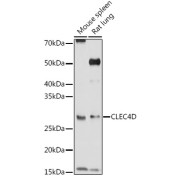
C-Type Lectin Domain Family 4 Member D (CLEC4D) Antibody
CLEC4D Antibody is a Rabbit Polyclonal antibody against CLEC4D. This gene encodes a member of the C-type lectin/C-type l…
Ver producto
C-Type Lectin Domain Family 4 Member D (CLEC4D) Antibody
This gene encodes a member of the C-type lectin/C-type lectin-like domain (CTL/CTLD) superfamily. Members of this family…
Ver producto
C-Type Lectin Domain Family 4 Member D (CLEC4D) Antibody
CLEC4D Antibody is a Rabbit Polyclonal against CLEC4D.…
Ver producto