Mouse CXCR3 (CXC-chemokine receptor 3) ELISA Kit
Contáctenos para saber el precio
Por favor contáctenos para obtener información detallada sobre el precio y disponibilidad.
Name
Mouse CXCR3 (CXC-chemokine receptor 3) ELISA Kit
Category
ELISA Kits
Provider
FineTest
Reference
EM0968
Tested Applications
ELISA
Documentos del producto
Instrucciones
Data sheet
Especificaciones del producto
| Category | ELISA Kits |
| Reactivity | Mouse |
| Detection Method | Colorimetric |
| Assay Data | 4 hours |
| Assay Type | Sandwich ELISA, Double Antibody |
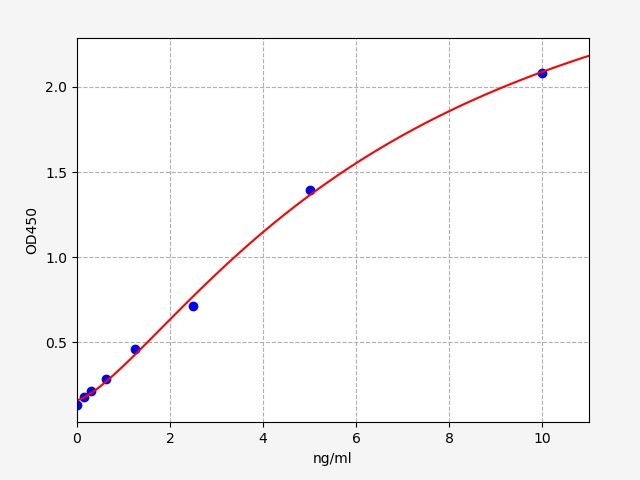
| Test Range | 0.156-10ng/ml |
| Sensitivity | 0.094ng/ml |
| Size 1 | 96T |
| Tested Applications | ELISA |
| Sample Type | Serum, Plasma, Cell Culture Supernatant, cell or tissue lysate, Other liquid samples |
| Availability | Shipped within 10-14 working days. |
| Storage | 2-8 °C for 12 months |
| UniProt ID | O88410 |
| Alias | CXCR3,GPR9,MigR,CD182,CD183,Mig-R,CKR-L2,CMKAR3,IP10-R,G protein-coupled receptor 9,CXC-R3,interferon-inducible protein 10 receptor,IP-10 receptor |
| Background | Elisa kits for CXCR3 |
| Status | RUO |
Background
CXCR3 is a G protein-coupled receptor (GPCR) primarily expressed on activated T cells, natural killer (NK) cells, and some epithelial cells. It binds chemokines such as CXCL9, CXCL10, and CXCL11, which are induced by interferon-gamma during inflammation. CXCR3 plays a critical role in T cell trafficking, promoting migration to inflammatory sites and tumor microenvironments. Its activation triggers signaling pathways like PI3K, MAPK, and JAK/STAT, leading to cell migration, proliferation, and cytokine production. CXCR3 has two main isoforms, CXCR3-A and CXCR3-B, which mediate different functions: CXCR3-A drives chemotaxis and immune cell recruitment, while CXCR3-B can induce apoptosis and inhibit cell migration under specific conditions. CXCR3 is implicated in autoimmune diseases like rheumatoid arthritis, multiple sclerosis, and inflammatory bowel disease, where aberrant T cell migration leads to chronic inflammation. In cancer, CXCR3 regulates both pro- and anti-tumor responses; while it facilitates immune cell infiltration into tumors, it can also enhance tumor cell metastasis and angiogenesis in some cancers. Its expression in tumor cells has been linked to poor prognosis, particularly in melanoma, breast, and lung cancers. Pharmacological targeting of CXCR3 is being explored to modulate immune responses, reduce inflammation, and improve cancer immunotherapy. Overall, CXCR3 is essential for immune cell migration, balancing immune surveillance and disease progression.
Productos relacionados
Chemokine C-X-C-Motif Receptor 3 (CXCR3) Antibody
This gene encodes a G protein-coupled receptor with selectivity for three chemokines, termed IP10 (interferon-g-inducibl…
Ver producto
Chemokine C-X-C-Motif Receptor 3 (CXCR3) Antibody
CXCR3 Antibody is a Rabbit Polyclonal antibody against CXCR3.…
Ver producto