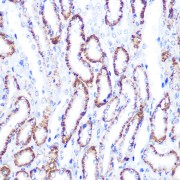
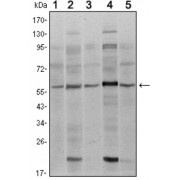
Mothers Against Decapentaplegic Homolog 4 (SMAD4) Peptide
Product Graph
195€ (100 µg)

Por favor contáctenos para obtener información detallada sobre el precio y disponibilidad.

935106861
info@markelab.com
name
Mothers Against Decapentaplegic Homolog 4 (SMAD4) Peptide
category
Proteins and Peptides
provider
Abbexa
reference
abx269049
tested applications
P-ELISA

Description

Mothers Against Decapentaplegic Homolog 4 (SMAD4) Peptide is a synthetic peptide. This peptide is used in the production of

Documents del producto

Instrucciones
Data sheet
Descargar

Product specifications

Category
Proteins and Peptides
Immunogen Target
Mothers Against Decapentaplegic Homolog 4 (SMAD4)
Host
Synthetic
Assay Type
Activity: Not tested.
Sequence Fragment: C-Terminus: C-HTMPIADPQPLD
Recommended Dilution
BL (predicted): 0.5 mg/ml. Optimal dilutions/concentrations should be determined by the end user.
Conjugation
Unconjugated
Size 1
100 µg
Form
Lyophilized
Tested Applications
P-ELISA
Buffer
Prior to lyophilization: Deionized water.
Availability
Shipped within 5-10 working days.
Storage
Aliquot and store at -20 °C. Avoid repeated freeze/thaw cycles.
Dry Ice
No
Gene ID
4089, 50554
NCBI Accession
NP_005350.1
Background
Protein SMAD4
Status
RUO
Note
THIS PRODUCT IS FOR RESEARCH USE ONLY. NOT FOR USE IN DIAGNOSTIC, THERAPEUTIC OR COSMETIC PROCEDURES. NOT FOR HUMAN OR ANIMAL CONSUMPTION.
Reconstitute in deionized water.

Descripción

Related Products

FNab07995

SMAD4 antibody

In muscle physiology, plays a central role in the balance between atrophy and hypertrophy. When recruited by MSTN, promotes atrophy response via phosphorylated SMAD2/4. MSTN decrease causes SMAD4 release and subsequent recruitment by the BMP pathway to promote hypertrophy via phosphorylated SMAD1/5/8. Acts synergistically with SMAD1 and YY1 in bone morphogenetic protein(BMP)-mediated cardiac-specific gene expression. Binds to SMAD binding elements(SBEs)(5'-GTCT/AGAC-3') within BMP response element(BMPRE) of cardiac activating regions(By similarity). Common SMAD(co-SMAD) is the coactivator and mediator of signal transduction by TGF-beta(transforming growth factor). Component of the heterotrimeric SMAD2/SMAD3-SMAD4 complex that forms in the nucleus and is required for the TGF-mediated signaling. Promotes binding of the SMAD2/SMAD4/FAST-1 complex to DNA and provides an activation function required for SMAD1 or SMAD2 to stimulate transcription. Component of the multimeric SMAD3/SMAD4/JUN/FOS complex which forms at the AP1 promoter site; required for synergistic transcriptional activity in response to TGF-beta. May act as a tumor suppressor. Positively regulates PDPK1 kinase activity by stimulating its dissociation from the 14-3-3 protein YWHAQ which acts as a negative regulator.

Ver Producto
FNab07996

SMAD4 antibody

In muscle physiology, plays a central role in the balance between atrophy and hypertrophy. When recruited by MSTN, promotes atrophy response via phosphorylated SMAD2/4. MSTN decrease causes SMAD4 release and subsequent recruitment by the BMP pathway to promote hypertrophy via phosphorylated SMAD1/5/8. Acts synergistically with SMAD1 and YY1 in bone morphogenetic protein(BMP)-mediated cardiac-specific gene expression. Binds to SMAD binding elements(SBEs)(5'-GTCT/AGAC-3') within BMP response element(BMPRE) of cardiac activating regions(By similarity). Common SMAD(co-SMAD) is the coactivator and mediator of signal transduction by TGF-beta(transforming growth factor). Component of the heterotrimeric SMAD2/SMAD3-SMAD4 complex that forms in the nucleus and is required for the TGF-mediated signaling. Promotes binding of the SMAD2/SMAD4/FAST-1 complex to DNA and provides an activation function required for SMAD1 or SMAD2 to stimulate transcription. Component of the multimeric SMAD3/SMAD4/JUN/FOS complex which forms at the AP1 promoter site; required for synergistic transcriptional activity in response to TGF-beta. May act as a tumor suppressor. Positively regulates PDPK1 kinase activity by stimulating its dissociation from the 14-3-3 protein YWHAQ which acts as a negative regulator.

Ver Producto
FNab07997

SMAD4 antibody

In muscle physiology, plays a central role in the balance between atrophy and hypertrophy. When recruited by MSTN, promotes atrophy response via phosphorylated SMAD2/4. MSTN decrease causes SMAD4 release and subsequent recruitment by the BMP pathway to promote hypertrophy via phosphorylated SMAD1/5/8. Acts synergistically with SMAD1 and YY1 in bone morphogenetic protein(BMP)-mediated cardiac-specific gene expression. Binds to SMAD binding elements(SBEs)(5'-GTCT/AGAC-3') within BMP response element(BMPRE) of cardiac activating regions(By similarity). Common SMAD(co-SMAD) is the coactivator and mediator of signal transduction by TGF-beta(transforming growth factor). Component of the heterotrimeric SMAD2/SMAD3-SMAD4 complex that forms in the nucleus and is required for the TGF-mediated signaling. Promotes binding of the SMAD2/SMAD4/FAST-1 complex to DNA and provides an activation function required for SMAD1 or SMAD2 to stimulate transcription. Component of the multimeric SMAD3/SMAD4/JUN/FOS complex which forms at the AP1 promoter site; required for synergistic transcriptional activity in response to TGF-beta. May act as a tumor suppressor. Positively regulates PDPK1 kinase activity by stimulating its dissociation from the 14-3-3 protein YWHAQ which acts as a negative regulator.

Ver Producto