MICOS complex subunit MIC26 (APOO) Antibody (FITC)
260€ (50 µl)
Por favor contáctenos para obtener información detallada sobre el precio y disponibilidad.
Name
MICOS complex subunit MIC26 (APOO) Antibody (FITC)
Category
Primary Antibodies
Provider
Abbexa
Reference
abx341267
Description
MICOS complex subunit MIC26 (APOO) Antibody (FITC) is a Rabbit Polyclonal antibody conjugated to FITC for the detection of Human APOO.
Documentos del producto
Instrucciones
Data sheet
Especificaciones del producto
| Category | Primary Antibodies |
| Immunogen Target | Target: MICOS complex subunit MIC26 (APOO) Immunogen: Recombinant Human MICOS complex subunit MIC26 protein (26-198 AA) |
| Host | Rabbit |
| Reactivity | Human |
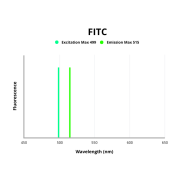
| Detection Method | Laser Line: 488 Excitation/Emission: 499/515 |
| Recommended Dilution | Optimal dilutions/concentrations should be determined by the end user. |
| Clonality | Polyclonal |
| Conjugation | FITC |
| Isotype | IgG |
| Purity | > 95% |
| Purification | Purified by Protein G chromatography. |
| Size 1 | 50 µl |
| Size 2 | 100 µl |
| Size 3 | 200 µl |
| Size 4 | 1 ml |
| Form | Liquid |
| Buffer | 0.01 M PBS, pH 7.4, 0.03% Proclin-300 and 50% glycerol. |
| Availability | Shipped within 5-10 working days. |
| Storage | Aliquot and store at -20°C. Avoid repeated freeze/thaw cycles. |
| Dry Ice | No |
| UniProt ID | Q9BUR5 |
| Alias | MIC26,MICOS26,FAM121B,My025,MIC23,Apolipoprotein O |
| Background | Antibody anti-APOO |
| Status | RUO |
| Note | THIS PRODUCT IS FOR RESEARCH USE ONLY. NOT FOR USE IN DIAGNOSTIC, THERAPEUTIC OR COSMETIC PROCEDURES. NOT FOR HUMAN OR ANIMAL CONSUMPTION. |
Background
Apolipoprotein O (APOO) is a lipid-associated protein that is primarily involved in lipid metabolism, mitochondrial function, and cardiovascular health. APOO is widely expressed in the heart, liver, skeletal muscle, and adipose tissues, where it associates with circulating lipoproteins such as high-density lipoproteins (HDL) and very-low-density lipoproteins (VLDL). APOO plays a critical role in modulating mitochondrial function and energy metabolism by influencing mitochondrial membrane integrity and regulating reactive oxygen species (ROS) production. Additionally, APOO has been implicated in the formation and secretion of lipoproteins, as well as the trafficking of cholesterol and triglycerides. Altered APOO expression has been observed in metabolic and cardiovascular diseases, including obesity, insulin resistance, and atherosclerosis, where it contributes to lipid accumulation, mitochondrial dysfunction, and oxidative stress. Recent findings suggest APOO may also play a role in regulating cellular responses to hypoxia and energy stress, highlighting its importance in maintaining cellular and mitochondrial homeostasis. As a key mediator of lipid metabolism and mitochondrial function, APOO is an emerging target for research into the prevention and treatment of metabolic disorders, cardiovascular diseases, and oxidative stress-related conditions. Further investigation is needed to fully elucidate APOO’s mechanisms and therapeutic potential in lipid homeostasis and mitochondrial health.
Productos relacionados
Apolipoprotein O (APOO) Antibody
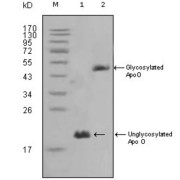
ApoO: apolipoprotein O, also known as MYO25, FAM121B, MGC4825. Entrez Protein NP077027. It is a chrondroitin-sulfate cha…
Ver producto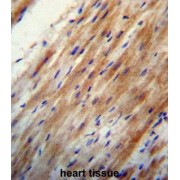
Apolipoprotein O (APOO) Antibody
This gene is a member of the apolipoprotein family. Members of this protein family are involved in the transport and met…
Ver producto
Apolipoprotein O (APOO) Antibody
Apolipoprotein O Antibody is a Rabbit Polyclonal against Apolipoprotein O.…
Ver producto