Insulin Receptor (INSR) Antibody
299€ (50 µl)
Por favor contáctenos para obtener información detallada sobre el precio y disponibilidad.
Name
Insulin Receptor (INSR) Antibody
Category
Primary Antibodies
Provider
Abbexa
Reference
abx402023
Tested Applications
ELISA, IF/ICC
Description
Insulin Receptor (INSR) Antibody is a Recombinant Rabbit Monoclonal antibody for the detection of Human INSR.
Documentos del producto
Instrucciones
Data sheet
Especificaciones del producto
| Category | Primary Antibodies |
| Immunogen Target | Target: Insulin Receptor (INSR) Immunogen: A synthesized peptide derived from human Insulin Receptor |
| Host | Rabbit |
| Reactivity | Human |
| Recommended Dilution | IF/ICC: 1/20 - 1/200. Optimal dilutions/concentrations should be determined by the end user. |
| Clonality | Monoclonal |
| Conjugation | Unconjugated |
| Isotype | IgG |
| Expression | Recombinant |
| Purification | Purified by affinity chromatography. |
| Size 1 | 50 µl |
| Size 2 | 100 µl |
| Form | Liquid |
| Tested Applications | ELISA, IF/ICC |
| Buffer | PBS, pH 7.4, 150 mM NaCl, 0.02% sodium azide and 50% glycerol. |
| Availability | Shipped within 5-10 working days. |
| Storage | Aliquot and store at -20°C. Avoid repeated freeze/thaw cycles. |
| Dry Ice | No |
| UniProt ID | P06213 |
| Alias | HHF5,CD220,IR |
| Background | Antibody anti-INSR |
| Status | RUO |
| Note | THIS PRODUCT IS FOR RESEARCH USE ONLY. NOT FOR USE IN DIAGNOSTIC, THERAPEUTIC OR COSMETIC PROCEDURES. NOT FOR HUMAN OR ANIMAL CONSUMPTION. |
Background
The insulin receptor (INSR) is a transmembrane protein essential for regulating glucose homeostasis, cellular growth, and metabolism. This receptor, which belongs to the receptor tyrosine kinase (RTK) family, is the primary signaling molecule for insulin, a hormone central to controlling blood sugar levels. By binding insulin, the INSR initiates a cascade of signaling pathways that drive glucose uptake, protein synthesis, lipid metabolism, and cell proliferation. Dysregulation of INSR signaling is implicated in various metabolic and endocrine diseases, most notably type 2 diabetes mellitus (T2DM), obesity, and insulin resistance-related disorders. The receptor’s role in modulating these critical physiological processes makes it a focus for therapeutic interventions and research in metabolic diseases.
Productos relacionados

INSR (pY1150) / IGF1R (pY1135) Antibody
INSR (pY1150) / IGF1R (pY1135) Antibody is a Rabbit Polyclonal antibody against INSR (pY1150) / IGF1R (pY1135). Type I i…
Ver producto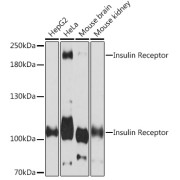
Insulin Receptor (INSR) Antibody
INSR Antibody is a Rabbit Polyclonal antibody against INSR. After removal of the precursor signal peptide, the insulin r…
Ver producto
Insulin Receptor (INSR) Antibody
Rabbit polyclonal antibody against IR protein. Immunogen region is C-terminal.…
Ver producto