Human Gastrin Releasing Peptide (GRP) Peptide
312€ (50 µg)
Por favor contáctenos para obtener información detallada sobre el precio y disponibilidad.
Name
Human Gastrin Releasing Peptide (GRP) Peptide
Category
Proteins and Peptides
Provider
Abbexa
Reference
abx660047
Tested Applications
BL
Description
Human Gastrin Releasing Peptide (GRP) Peptide is a Synthetic Human peptide.
Documentos del producto
Instrucciones
Data sheet
Especificaciones del producto
| Category | Proteins and Peptides |
| Immunogen Target | Gastrin Releasing Peptide (GRP) |
| Assay Type | Activity: Not tested Sequence Fragment: Please enquire. Tag: N-terminal His Tag |
| Origin | Human |
| Conjugation | Unconjugated |
| Observed MW | Calculated MW: 1.7 kDa |
| Expression | Synthetic |
| Purity | > 90% |
| Size 1 | 50 µg |
| Size 2 | 100 µg |
| Size 3 | 200 µg |
| Size 4 | 500 µg |
| Size 5 | 1 mg |
| Form | Lyophilized |
| Tested Applications | BL |
| Buffer | Prior to lyophilization: PBS, pH 7.4, containing 0.01% Sarcosyl, 1 mM DTT, 5% Trehalose and Proclin-300. |
| Availability | Shipped within 5-15 working days. |
| Storage | Store lyophilized form at 2-8°C for up to 1 month. For longer periods, store lyophilized or liquid at -80°C. Avoid repeated freeze–thaw cycles. |
| Dry Ice | No |
| UniProt ID | P07492 |
| Background | Protein GRP |
| Status | RUO |
| Note | THIS PRODUCT IS FOR RESEARCH USE ONLY. NOT FOR USE IN DIAGNOSTIC, THERAPEUTIC OR COSMETIC PROCEDURES. NOT FOR HUMAN OR ANIMAL CONSUMPTION. To keep the original salt concentration, we recommend reconstituting to the original concentration prior to lyophilization (see Concentration) in ddH2O. If a lower concentration is required, dilute in PBS, pH 7.4. If a higher concentration is required, the product can be reconstituted directly in PBS, pH 7.4, though please note that this will change the overall salt concentration. The stock concentration should be between 0.1-1.0 mg/ml. Do not vortex. Concentration: Prior to lyophilization: 200 µg/ml |
Productos relacionados
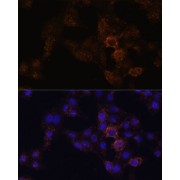
Gastrin-Releasing Peptide (GRP) Antibody
GRP Antibody is a Rabbit Polyclonal antibody against GRP. This gene encodes a member of the bombesin-like family of gast…
Ver producto
Gastrin Releasing Peptide (GRP) Antibody (Biotin)
Gastrin-releasing peptide Antibody (Biotin) is a Rabbit Polyclonal antibody against Gastrin-releasing peptide conjugated…
Ver producto
Gastrin Releasing Peptide (GRP) Antibody (FITC)
Gastrin-releasing peptide Antibody (FITC) is a Rabbit Polyclonal antibody against Gastrin-releasing peptide conjugated t…
Ver producto