Human DNA-(Apurinic Or Apyrimidinic Site) Lyase (APEX1) Protein

Product Graph
234€ (2 µg)

Por favor contáctenos para obtener información detallada sobre el precio y disponibilidad.

935106861
info@markelab.com
name
Human DNA-(Apurinic Or Apyrimidinic Site) Lyase (APEX1) Protein
category
Proteins and Peptides
provider
Abbexa
reference
abx073692
tested applications
SDS-PAGE

Description

Human DNA-(Apurinic Or Apyrimidinic Site) Lyase is a recombinant protein expressed in E.coli.

Documents del producto

Instrucciones
Data sheet
Descargar

Product specifications

Category
Proteins and Peptides
Immunogen Target
DNA-(Apurinic Or Apyrimidinic Site) Lyase (APEX1)
Host
E. coli
Recommended Dilution
Optimal dilutions/concentrations should be determined by the end user.
Origin
Human
Observed MW
Molecular Weight: 36.9 kDa

Concentration: 1 mg/ml

Sequence Fragment: 1-318 AA.

Tag: N-terminal T7-tag
Expression
Recombinant
Purity
> 90% (SDS-PAGE)
Purification
Purified by standard chromatography.
Size 1
2 µg
Size 2
10 µg
Size 3
1 mg
Form
Liquid
Tested Applications
SDS-PAGE
Buffer
20 mM Tris-HCl, pH 8.0, containing 2 mM DTT, 0.2 M NaCl and 10% glycerol.
Availability
Shipped within 5-10 working days.
Storage
Store at 4 °C if the entire vial will be used within 4 weeks. Store at -20 °C for long-term storage. Avoid repeated freeze/thaw cycles.
Dry Ice
No
UniProt ID
P27695
Alias
APEX1,APE,APE1,APEX,APX
Background
Protein APEX1
Status
RUO
Note
This product is for research use only.   Not for human consumption, cosmetic, therapeutic or diagnostic use.

Descripción

Related Products

EH2009

Human APEX1 (DNA- (apurinic or apyrimidinic site) lyase) ELISA Kit

Ver Producto
FNab00479

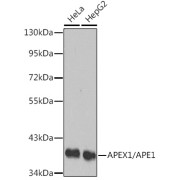
APEX1 antibody

Apurinic/apyrimidinic (AP) sites occur frequently in DNA molecules by spontaneous hydrolysis, by DNA damaging agents or by DNA glycosylases that remove specific abnormal bases. AP sites are pre-mutagenic lesions that can prevent normal DNA replication so the cell contains systems to identify and repair such sites. Class II AP endonucleases cleave the phosphodiester backbone 5' to the AP site. This gene encodes the major AP endonuclease in human cells. Splice variants have been found for this gene; all encode the same protein.

Ver Producto
FNab00480

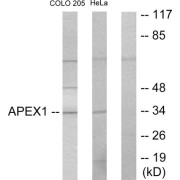
APEX1 antibody

Multifunctional protein that plays a central role in the cellular response to oxidative stress. The two major activities of APEX1 in DNA repair and redox regulation of transcriptional factors. Functions as a apurinic/apyrimidinic(AP) endodeoxyribonuclease in the DNA base excision repair(BER) pathway of DNA lesions induced by oxidative and alkylating agents. Initiates repair of AP sites in DNA by catalyzing hydrolytic incision of the phosphodiester backbone immediately adjacent to the damage, generating a single-strand break with 5'-deoxyribose phosphate and 3'-hydroxyl ends. Does also incise at AP sites in the DNA strand of DNA/RNA hybrids, single-stranded DNA regions of R-loop structures, and single-stranded RNA molecules. Has a 3'-5' exoribonuclease activity on mismatched deoxyribonucleotides at the 3' termini of nicked or gapped DNA molecules during short-patch BER. Possesses a DNA 3' phosphodiesterase activity capable of removing lesions(such as phosphoglycolate) blocking the 3' side of DNA strand breaks. May also play a role in the epigenetic regulation of gene expression by participating in DNA demethylation. Acts as a loading factor for POLB onto non-incised AP sites in DNA and stimulates the 5'-terminal deoxyribose 5'-phosphate(dRp) excision activity of POLB. Plays a role in the protection from granzymes-mediated cellular repair leading to cell death. Also involved in the DNA cleavage step of class switch recombination(CSR). On the other hand, APEX1 also exerts reversible nuclear redox activity to regulate DNA binding affinity and transcriptional activity of transcriptional factors by controlling the redox status of their DNA-binding domain, such as the FOS/JUN AP-1 complex after exposure to IR. Involved in calcium-dependent down-regulation of parathyroid hormone(PTH) expression by binding to negative calcium response elements(nCaREs). Together with HNRNPL or the dimer XRCC5/XRCC6, associates with nCaRE, acting as an activator of transcriptional repression. Stimulates the YBX1-mediated MDR1 promoter activity, when acetylated at Lys-6 and Lys-7, leading to drug resistance. Acts also as an endoribonuclease involved in the control of single-stranded RNA metabolism. Plays a role in regulating MYC mRNA turnover by preferentially cleaving in between UA and CA dinucleotides of the MYC coding region determinant(CRD). In association with NMD1, plays a role in the rRNA quality control process during cell cycle progression. Associates, together with YBX1, on the MDR1 promoter. Together with NPM1, associates with rRNA. Binds DNA and RNA.

Ver Producto