Human 14-3-3 Protein Epsilon (YWHAE) Protein
338€ (10 µg)
Por favor contáctenos para obtener información detallada sobre el precio y disponibilidad.
Name
Human 14-3-3 Protein Epsilon (YWHAE) Protein
Category
Proteins and Peptides
Provider
Abbexa
Reference
abx693154
Tested Applications
SDS-PAGE
Description
14-3-3 Protein Epsilon (YWHAE) protein is a recombinant Human protein expressed in E. coli.
Documentos del producto
Instrucciones
Data sheet
Especificaciones del producto
| Category | Proteins and Peptides |
| Immunogen Target | 14-3-3 Protein Epsilon (YWHAE) |
| Host | E. coli |
| Assay Type | Activity: Not tested Sequence Fragment: Met1-Gln255 Tag: N-terminal GST tag |
| Origin | Human |
| Observed MW | 56 kDa |
| Expression | Recombinant |
| Purity | > 90% (SDS-PAGE) |
| Size 1 | 10 µg |
| Size 2 | 50 µg |
| Form | Lyophilized |
| Tested Applications | SDS-PAGE |
| Buffer | 20 mM PBS, 150 mM NaCl, pH 7.2. |
| Availability | Shipped within 5-15 working days. |
| Storage | Storage: Store lyophilized between -20 °C and -80°C. Stability: Stable when stored reconstituted at 2-8°C for up to 1 week. Reconstituted aliquots are stable at -20°C for up to 3 months. Shelf Life: 12 months. |
| Dry Ice | No |
| UniProt ID | P62258 |
| Alias | YWHAE, 14-3-3E, HEL2, KCIP-1, MDCR, MDS,14-3-3 epsilon |
| Background | Protein YWHAE |
| Status | RUO |
| Note | THIS PRODUCT IS FOR RESEARCH USE ONLY. NOT FOR USE IN DIAGNOSTIC, THERAPEUTIC OR COSMETIC PROCEDURES. NOT FOR HUMAN OR ANIMAL CONSUMPTION. Endotoxin Level: < 1.0 EU per µg (LAL method). |
Background
YWHAE, another member of the 14-3-3 family, functions as an adaptor protein that regulates protein-protein interactions, cellular localization, and stability of signaling molecules. By binding to phosphorylated targets, YWHAE modulates pathways such as MAPK, Wnt/β-catenin, and PI3K/Akt, controlling processes like cell proliferation, apoptosis, and cytoskeletal dynamics. It is highly expressed in neuronal tissues, where it plays critical roles in brain development, axon guidance, and synaptic function. YWHAE also regulates the DNA damage response and tumor suppression pathways by interacting with proteins like p53 and Chk1. Dysregulation of YWHAE is linked to developmental disorders, including Miller-Dieker syndrome and neurodevelopmental abnormalities, as well as cancers where it promotes tumor progression and metastasis. Knockout models exhibit defects in brain development, impaired cell migration, and increased susceptibility to stress, emphasizing its role in neurodevelopment, cell signaling, and maintaining cellular integrity.
Productos relacionados
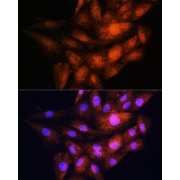
14-3-3 Protein Epsilon (YWHAE) Antibody
YWHAE Antibody is a Rabbit Polyclonal antibody against YWHAE. This gene product belongs to the 14-3-3 family of proteins…
Ver producto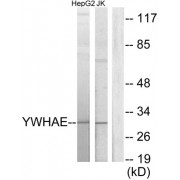
14-3-3 Protein Epsilon (YWHAE) Antibody
Rabbit polyclonal antibody against 14-3-3 epsilon protein. Immunogen region is C-terminal.…
Ver producto
Human 14-3-3 Protein Epsilon (YWHAE) Protein
Tyr-3/Trp-5 Monooxygenase Activation Protein, Epsilon Protein is a recombinant protein kinase.…
Ver producto