APOL1 antibody

Contáctenos para saber el precio
Por favor contáctenos para obtener información detallada sobre el precio y disponibilidad.
Name
APOL1 antibody
Category
Primary Antibodies
Provider
FineTest
Reference
FNab00503
Tested Applications
ELISA, WB, IHC, FC
Description
May play a role in lipid exchange and transport throughout the body. May participate in reverse cholesterol transport from peripheral cells to the liver.
Documentos del producto
Especificaciones del producto
| Category | Primary Antibodies |
| Immunogen Target | apolipoprotein L, 1 (APOL1) |
| Host | Mouse |
| Reactivity | Human |
| Recommended Dilution | WB: 1:10000-1:50000; IHC: 1:50-1:500 |
| Clonality | monoclonal |
| Conjugation | Unconjugated |
| Isotype | IgG2a |
| Clone ID | 5E2 |
| Observed MW | 44 kDa |
| Purity | ≥95% as determined by SDS-PAGE |
| Purification | Protein A+G purification |
| Size 1 | 100µg |
| Form | liquid |
| Tested Applications | ELISA, WB, IHC, FC |
| Storage | PBS with 0.02% sodium azide and 50% glycerol pH 7.3, -20℃ for 12 months(Avoid repeated freeze / thaw cycles.) |
| UniProt ID | O14791 |
| Gene ID | 8542 |
| Alias | APOL1, APO-L, APOL, APOL-I, FSGS4, apolipoprotein L1, APO L1 |
| Background | Antibody anti-APOL1 |
| Status | RUO |
| Note | Mol. Weight 44 kDa |
Background
Apolipoprotein L1 (APOL1) is a member of the Apolipoprotein L gene family and plays a critical role in lipid transport and innate immunity. APOL1 is primarily expressed in the liver, kidney, and vascular endothelium and is known for its ability to bind high-density lipoprotein (HDL) particles, contributing to lipid transport and cholesterol metabolism. A particularly vital function of APOL1 lies in its role in innate immunity, as it helps protect against trypanosome infections. APOL1 can lyse trypanosomes such as Trypanosoma brucei, which cause African sleeping sickness, by disrupting their cellular membranes. Genetic variations, specifically the G1 and G2 risk alleles, have been associated with increased susceptibility to kidney diseases, such as focal segmental glomerulosclerosis (FSGS) and HIV-associated nephropathy (HIVAN), particularly in people of African descent. These alleles enhance APOL1-mediated trypanosome resistance but lead to cytotoxic effects in kidney cells under specific stress conditions. APOL1’s dual role as both a defender against pathogens and a contributor to renal disease makes it a subject of intensive research. Targeting APOL1 signaling pathways may provide therapeutic options for managing kidney diseases and understanding its broader impact on lipid metabolism and immune responses.
Productos relacionados

Apolipoprotein L (APOL1) Antibody
APOL1 Antibody is a Rabbit Polyclonal Antibody against APOL1.…
Ver producto
Apolipoprotein L (APOL1) Antibody
Rabbit polyclonal antibody against APOL1 protein. Immunogen region is Internal.…
Ver producto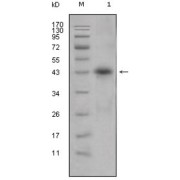
Apolipoprotein L (APOL1) Antibody
APOL1 (apolipoprotein L, 1), also known as APOL, APO-L, APOL-I.Entrez Protein NP_001130012.It is a 395aa secreted high d…
Ver producto