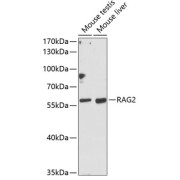
Recombination Activating Gene 2 (RAG2) Antibody

Product Graph
292.5€ (80 µl)

Por favor contáctenos para obtener información detallada sobre el precio y disponibilidad.

935106861
info@markelab.com
name
Recombination Activating Gene 2 (RAG2) Antibody
category
Primary Antibodies
provider
Abbexa
reference
abx026817
tested applications
ELISA, WB, IHC, FCM

Description

This product is currently in development. The lead time for this product may be several months. Please contact us at

Documents del producto

Instrucciones
Data sheet
Descargar

Product specifications

Category
Primary Antibodies
Immunogen Target
Target: Recombination Activating Gene 2 (RAG2)
Immunogen: KLH-conjugated synthetic peptide between 349-377 amino acids from the C-terminal region of human RAG2.
Host
Rabbit
Reactivity
Human, Mouse
Recommended Dilution
WB: 1/1000, IHC-P: 1/10 - 1/50, FCM: 1/10 - 1/50. Not tested in IHC-F. Optimal dilutions/concentrations should be determined by the end user.
Clonality
Polyclonal
Conjugation
Unconjugated
Isotype
IgG
Observed MW
Calculated MW: 59.2 kDa
Purification
Purified through a protein A column, followed by peptide affinity purification.
Size 1
80 µl
Size 2
400 µl
Form
Liquid
Tested Applications
ELISA, WB, IHC, FCM
Buffer
PBS containing 0.09% sodium azide.
Availability
Please enquire.
Storage
Aliquot and store at -20°C. Avoid repeated freeze/thaw cycles.
Dry Ice
No
UniProt ID
P55895
Background
Antibody anti-RAG2
Status
RUO
Note
THIS PRODUCT IS FOR RESEARCH USE ONLY. NOT FOR USE IN DIAGNOSTIC, THERAPEUTIC OR COSMETIC PROCEDURES. NOT FOR HUMAN OR ANIMAL CONSUMPTION.

Descripción

Related Products

EH1809

Human RAG2 (V (D) J recombination-activating protein 2) ELISA Kit

Ver Producto
FNab07089

RAG2 antibody

Core component of the RAG complex, a multiprotein complex that mediates the DNA cleavage phase during V(D)J recombination. V(D)J recombination assembles a diverse repertoire of immunoglobulin and T-cell receptor genes in developing B and T-lymphocytes through rearrangement of different V(variable), in some cases D(diversity), and J(joining) gene segments. DNA cleavage by the RAG complex occurs in 2 steps: a first nick is introduced in the top strand immediately upstream of the heptamer, generating a 3'-hydroxyl group that can attack the phosphodiester bond on the opposite strand in a direct transesterification reaction, thereby creating 4 DNA ends: 2 hairpin coding ends and 2 blunt, 5'-phosphorylated ends. The chromatin structure plays an essential role in the V(D)J recombination reactions and the presence of histone H3 trimethylated at 'Lys-4'(H3K4me3) stimulates both the nicking and haipinning steps. The RAG complex also plays a role in pre-B cell allelic exclusion, a process leading to expression of a single immunoglobulin heavy chain allele to enforce clonality and monospecific recognition by the B-cell antigen receptor(BCR) expressed on individual B-lymphocytes. The introduction of DNA breaks by the RAG complex on one immunoglobulin allele induces ATM-dependent repositioning of the other allele to pericentromeric heterochromatin, preventing accessibility to the RAG complex and recombination of the second allele. In the RAG complex, RAG2 is not the catalytic component but is required for all known catalytic activities mediated by RAG1. It probably acts as a sensor of chromatin state that recruits the RAG complex to H3K4me3(By similarity).

Ver Producto
abx004301

Recombination Activating Gene 2 (RAG2) Antibody

RAG2 Antibody is a Rabbit Polyclonal antibody against RAG2. This gene encodes a protein that is involved in the initiation of V(D)J recombination during B and T cell development. This protein forms a complex with the product of the adjacent recombination activating gene 1, and this complex can form double-strand breaks by cleaving DNA at conserved recombination signal sequences. The recombination activating gene 1 component is thought to contain most of the catalytic activity, while the N-terminal of the recombination activating gene 2 component is thought to form a six-bladed propeller in the active core that serves as a binding scaffold for the tight association of the complex with DNA. A C-terminal plant homeodomain finger-like motif in this protein is necessary for interactions with chromatin components, specifically with histone H3 that is trimethylated at lysine 4. Mutations in this gene cause Omenn syndrome, a form of severe combined immunodeficiency associated with autoimmune-like symptoms.

Ver Producto