RAD9 Checkpoint Clamp Component A (RAD9A) Antibody
195€ (20 µl)
Por favor contáctenos para obtener información detallada sobre el precio y disponibilidad.
Name
RAD9 Checkpoint Clamp Component A (RAD9A) Antibody
Category
Primary Antibodies
Provider
Abbexa
Reference
abx001552
Tested Applications
ELISA, WB, IHC
Description
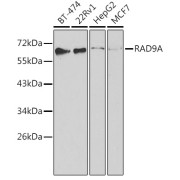
RAD9A Antibody is a Rabbit Polyclonal antibody against RAD9A. This gene product is highly similar to Schizosaccharomyces pombe rad9, a cell cycle checkpoint protein required for cell cycle arrest and DNA damage repair. This protein possesses 3' to 5' exonuclease activity, which may contribute to its role in sensing and repairing DNA damage. It forms a checkpoint protein complex with RAD1 and HUS1. This complex is recruited by checkpoint protein RAD17 to the sites of DNA damage, which is thought to be important for triggering the checkpoint-signaling cascade. Alternatively spliced transcript variants encoding different isoforms have been found for this gene. [provided by RefSeq, Aug 2011].
Documentos del producto
Instrucciones
Data sheet
Especificaciones del producto
| Category | Primary Antibodies |
| Immunogen Target | Target: RAD9 Checkpoint Clamp Component A (RAD9A) Immunogen: Recombinant protein corresponding to RAD9A. The exact sequence is proprietary. |
| Host | Rabbit |
| Reactivity | Human, Rat |
| Assay Type | Concentration: > 0.2 mg/ml |
| Recommended Dilution | ELISA: 1 µg/ml, WB: 1/500 - 1/2000, IHC-P: 1/50 - 1/200. Not tested in IHC-F. Optimal dilutions/concentrations should be determined by the end user. |
| Clonality | Polyclonal |
| Conjugation | Unconjugated |
| Isotype | IgG |
| Observed MW | Calculated MW: 43 kDa Observed MW: 60 kDa |
| Purification | Purified by affinity chromatography. |
| Size 1 | 20 µl |
| Size 2 | 100 µl |
| Size 3 | 2 × 100 µl |
| Form | Liquid |
| Tested Applications | ELISA, WB, IHC |
| Buffer | PBS, pH 7.3, containing 0.02% sodium azide, 50% glycerol. |
| Availability | Shipped within 5-10 working days. |
| Storage | Aliquot and store at -20°C. Avoid repeated freeze/thaw cycles. |
| Dry Ice | No |
| UniProt ID | Q99638 |
| Gene ID | 5883 |
| NCBI Accession | NP_004575.1 |
| Background | Antibody anti-RAD9A |
| Status | RUO |
| Note | THIS PRODUCT IS FOR RESEARCH USE ONLY. NOT FOR USE IN DIAGNOSTIC, THERAPEUTIC OR COSMETIC PROCEDURES. NOT FOR HUMAN OR ANIMAL CONSUMPTION. |
Productos relacionados
RAD9 Checkpoint Clamp Component A (RAD9A) Antibody
RAD9A Antibody is a Rabbit Polyclonal antibody against RAD9A. This gene product is highly similar to Schizosaccharomyces…
Ver producto
Cell Cycle Checkpoint Control Protein RAD9A Phospho-Ser328 (RAD9A pS328) Antibody
Rad9 is highly similar to Schizosaccharomyces pombe rad9, a cell cycle checkpoint protein required for cell cycle arrest…
Ver producto
RAD9 Checkpoint Clamp Component A (RAD9A) Antibody
RAD9A Antibody is a Rabbit Polyclonal against RAD9A.…
Ver producto