Paired Box 3 (PAX3) Peptide
195€ (100 µg)
Por favor contáctenos para obtener información detallada sobre el precio y disponibilidad.
Name
Paired Box 3 (PAX3) Peptide
Category
Proteins and Peptides
Provider
Abbexa
Reference
abx616744
Tested Applications
P-ELISA
Description
Paired Box 3 (PAX3) Peptide is a synthetic peptide. This peptide is used in the production of
Documentos del producto
Instrucciones
Data sheet
Especificaciones del producto
| Category | Proteins and Peptides |
| Immunogen Target | Paired Box 3 (PAX3) |
| Host | Synthetic |
| Assay Type | Activity: Not tested. Sequence Fragment: Internal region: C-STVHQSTIPSNPD |
| Recommended Dilution | BL (predicted): 0.5 mg/ml. Optimal dilutions/concentrations should be determined by the end user. |
| Conjugation | Unconjugated |
| Size 1 | 100 µg |
| Form | Lyophilized |
| Tested Applications | P-ELISA |
| Buffer | Prior to lyophilization: Deionized water. |
| Availability | Shipped within 5-10 working days. |
| Storage | Aliquot and store at -20 °C. Avoid repeated freeze/thaw cycles. |
| Dry Ice | No |
| Gene ID | 5077, 18505, 114502 |
| NCBI Accession | NP_852122.1, NP_000429.2, NP_039230.1, NP_852123.1, NP_852124.1, NP_852126.1, NP_852125.1, NP_001120838.1 |
| Alias | CDHS,HUP2,PAX-3,WS1,WS3 |
| Background | Protein PAX3 |
| Status | RUO |
| Note | THIS PRODUCT IS FOR RESEARCH USE ONLY. NOT FOR USE IN DIAGNOSTIC, THERAPEUTIC OR COSMETIC PROCEDURES. NOT FOR HUMAN OR ANIMAL CONSUMPTION. Reconstitute in deionized water. |
Productos relacionados

Paired Box Protein Pax-3 (PAX3) Antibody
PAX3 Antibody is a Rabbit Polyclonal antibody against PAX3. This gene is a member of the paired box (PAX) family of tran…
Ver producto
Paired Box 3 (PAX3) Antibody
This gene is a member of the paired box (PAX) family of transcription factors.Members of the PAX family typically contai…
Ver producto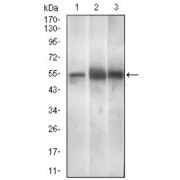
Paired Box 3 (PAX3) Antibody
This gene is a member of the paired box (PAX) family of transcription factors.Members of the PAX family typically contai…
Ver producto