Myc Proto-Oncogene Protein (MYC) Antibody (HRP)
169€ (20 µg)
Por favor contáctenos para obtener información detallada sobre el precio y disponibilidad.
Name
Myc Proto-Oncogene Protein (MYC) Antibody (HRP)
Category
Primary Antibodies
Provider
Abbexa
Reference
abx305922
Tested Applications
ELISA
Description
MYC Antibody (HRP) is a Rabbit Polyclonal against MYC conjugated to HRP.
Documentos del producto
Instrucciones
Data sheet
Especificaciones del producto
| Category | Primary Antibodies |
| Immunogen Target | Target: Myc Proto-Oncogene Protein (MYC) Immunogen: Recombinant human Myc proto-oncogene protein (1-439AA). |
| Host | Rabbit |
| Reactivity | Human |
| Recommended Dilution | Optimal dilutions/concentrations should be determined by the end user. |
| Clonality | Polyclonal |
| Conjugation | HRP |
| Isotype | IgG |
| Purity | > 95% |
| Purification | Purified by Protein G. |
| Size 1 | 20 µg |
| Size 2 | 50 µg |
| Size 3 | 100 µg |
| Size 4 | 200 µg |
| Size 5 | 1 mg |
| Form | Liquid |
| Tested Applications | ELISA |
| Buffer | 0.01 M PBS, pH 7.4, 0.03% Proclin-300 and 50% Glycerol. |
| Availability | Shipped within 5-10 working days. |
| Storage | Aliquot and store at -20°C. Avoid exposure to light. Avoid repeated freeze/thaw cycles. |
| Dry Ice | No |
| UniProt ID | P01106 |
| Gene ID | 4609 |
| NCBI Accession | NP_002458.2, NM_002467.4 |
| OMIM | 113970 |
| Alias | MRTL,MYCC,c-Myc,bHLHe39,Transcription factor p64,Proto-oncogene c-Myc,Class E basic helix-loop-helix protein 39 |
| Background | Antibody anti-MYC |
| Status | RUO |
| Note | THIS PRODUCT IS FOR RESEARCH USE ONLY. NOT FOR USE IN DIAGNOSTIC, THERAPEUTIC OR COSMETIC PROCEDURES. NOT FOR HUMAN OR ANIMAL CONSUMPTION. |
Background
The MYC proto-oncogene encodes a basic helix-loop-helix (bHLH) transcription factor that is central to regulating cell growth, proliferation, and metabolism. It acts as a master regulator by binding to E-box sequences within the genome to control the transcription of numerous genes involved in key cellular processes, such as ribosome biogenesis, cell cycle progression, and apoptosis. Dysregulation of MYC, often through overexpression or amplification, is a hallmark of many cancers, including Burkitt lymphoma and various solid tumors. This dysregulation promotes uncontrolled cell proliferation and impairs apoptosis, contributing to tumorigenesis. Additionally, MYC interacts with multiple co-factors and chromatin-modifying complexes, further amplifying its impact on the epigenetic landscape. Given its critical role in oncogenesis, MYC is extensively studied as a therapeutic target, with ongoing efforts to develop strategies to inhibit its activity or downstream pathways to treat MYC-driven malignancies. Its widespread effects on cellular physiology underscore its importance in both normal development and disease.
Productos relacionados

MYC (pT58) Antibody
MYC (pT58) Antibody is a Rabbit Polyclonal antibody against MYC (pT58). The protein encoded by this gene is a multifunct…
Ver producto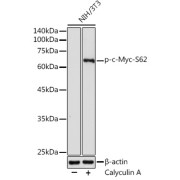
MYC (pS62) Antibody
MYC (pS62) Antibody is a Rabbit Polyclonal antibody against MYC (pS62). The protein encoded by this gene is a multifunct…
Ver producto
MYC (pS373) Antibody
MYC (pS373) Antibody is a Rabbit Polyclonal antibody against MYC (pS373). The protein encoded by this gene is a multifun…
Ver producto