Mouse Rac-Gamma Serine / Threonine-Protein Kinase (AKT3) Protein
975€ (50 µg)
Por favor contáctenos para obtener información detallada sobre el precio y disponibilidad.
Name
Mouse Rac-Gamma Serine / Threonine-Protein Kinase (AKT3) Protein
Category
Proteins and Peptides
Provider
Abbexa
Reference
abx693629
Tested Applications
SDS-PAGE
Description
Rac-Gamma Serine / Threonine-Protein Kinase (AKT3) protein is a recombinant Mouse protein expressed in Insect.
Documentos del producto
Instrucciones
Data sheet
Especificaciones del producto
| Category | Proteins and Peptides |
| Immunogen Target | Rac-Gamma Serine / Threonine-Protein Kinase (AKT3) |
| Host | Insect |
| Assay Type | Activity: Not tested Sequence Fragment: Ala106-Glu479 Tag: N-terminal His tag and GST tag |
| Origin | Mouse |
| Observed MW | 71 kDa |
| Expression | Recombinant |
| Purity | > 90% (SDS-PAGE) |
| Size 1 | 50 µg |
| Form | Lyophilized |
| Tested Applications | SDS-PAGE |
| Buffer | Prior to lyophilization: Sterile 20 mM Tris, 500 mM Nacl, pH 7.4, 10% glycerol. |
| Availability | Shipped within 5-15 working days. |
| Storage | Storage: Store lyophilized between -20 °C and -80°C. Stability: Stable when stored reconstituted at 2-8°C for up to 1 week. Reconstituted aliquots are stable at -20°C for up to 3 months. Shelf Life: 12 months. |
| Dry Ice | No |
| UniProt ID | Q9WUA6-1 |
| Alias | AKT3,PKBG,RAC-PK-gamma,STK-2 |
| Background | Protein AKT3 |
| Status | RUO |
| Note | THIS PRODUCT IS FOR RESEARCH USE ONLY. NOT FOR USE IN DIAGNOSTIC, THERAPEUTIC OR COSMETIC PROCEDURES. NOT FOR HUMAN OR ANIMAL CONSUMPTION. Endotoxin Level: < 1.0 EU per µg (LAL method). |
Background
AKT3, also known as RAC-gamma serine/threonine-protein kinase, is one of the three isoforms of the AKT (Protein Kinase B) family of serine/threonine kinases. Like AKT1 and AKT2, AKT3 plays a crucial role in regulating various cellular processes, including cell survival, proliferation, growth, and metabolism. AKT3 is activated downstream of the phosphoinositide 3-kinase (PI3K) signaling pathway, which is activated by growth factors and other extracellular stimuli. Activation of AKT3 occurs through phosphorylation at key residues, including threonine 305 (Thr305) and serine 472 (Ser472). Once activated, AKT3 phosphorylates a wide range of substrates involved in diverse cellular functions. While AKT1 and AKT2 are ubiquitously expressed in many tissues, AKT3 exhibits a more restricted pattern of expression, with higher expression levels observed in the brain, heart, and skeletal muscle. This tissue-specific expression pattern suggests distinct roles for AKT3 in these tissues. AKT3 is involved in brain development and neuronal survival. Studies have shown that AKT3 plays a critical role in regulating neuronal migration, axon outgrowth, and dendritic arborization during brain development. Dysregulation of AKT3 signaling has been implicated in various neurological disorders, including autism spectrum disorders and epilepsy. AKT3 is also involved in other cellular processes such as cell proliferation, survival, and metabolism. Dysregulation of AKT3 signaling has been implicated in various diseases, including cancer, metabolic disorders, and cardiovascular diseases.
Productos relacionados
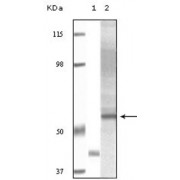
RAC-Gamma Serine/threonine-Protein Kinase (Akt3) Antibody
Akt3 (also designated protein kinase B gamma or v-akt murine thymoma viral oncogene homolog 3), with 479-amino acid prot…
Ver producto
RAC-Gamma Serine/threonine-Protein Kinase (AKT3) Antibody
AKT3 is a member of the AKT, also called PKB, serine/threonine protein kinase family. AKT kinases are known to be regula…
Ver producto
AKT3 (pS472) Antibody
AKT3 is a member of the AKT, also called PKB, serine/threonine protein kinase family. AKT kinases are known to be regula…
Ver producto