Human Vascular Cell Adhesion Molecule-1 (VCAM1) Protein
364€ (10 µg)
Por favor contáctenos para obtener información detallada sobre el precio y disponibilidad.
Name
Human Vascular Cell Adhesion Molecule-1 (VCAM1) Protein
Category
Proteins and Peptides
Provider
Abbexa
Reference
abx682053
Tested Applications
SDS-PAGE
Description
Human Vascular Cell Adhesion Molecule-1 (VCAM1) Protein is a recombinant Human protein expressed in E. coli.
Documentos del producto
Instrucciones
Data sheet
Especificaciones del producto
| Category | Proteins and Peptides |
| Immunogen Target | Vascular Cell Adhesion Molecule-1 (VCAM1) |
| Host | E. coli |
| Assay Type | Activity: Not tested |
| Recommended Dilution | Optimal dilutions/concentrations should be determined by the end user. |
| Origin | Human |
| Conjugation | Unconjugated |
| Expression | Recombinant |
| Size 1 | 10 µg |
| Size 2 | 100 µg |
| Size 3 | 1 mg |
| Form | Liquid |
| Tested Applications | SDS-PAGE |
| Availability | Shipped within 10-20 working days. |
| Storage | Aliquot and store at -20 °C. |
| Dry Ice | No |
| UniProt ID | P19320 |
| Alias | V-CAM 1,VCAM-1,INCAM-100,CD106 |
| Background | Protein VCAM1 |
| Status | RUO |
| Note | THIS PRODUCT IS FOR RESEARCH USE ONLY. NOT FOR USE IN DIAGNOSTIC, THERAPEUTIC OR COSMETIC PROCEDURES. NOT FOR HUMAN OR ANIMAL CONSUMPTION. |
Background
VCAM1 is a transmembrane glycoprotein and member of the immunoglobulin superfamily that plays a key role in cell adhesion, particularly in leukocyte-endothelial interactions during inflammation VCAM1 is expressed on endothelial cells in response to pro-inflammatory cytokines such as TNF-α and IL-1β where it mediates the adhesion and transmigration of leukocytes, including monocytes and lymphocytes, into inflamed tissues VCAM1 interacts with its ligand VLA-4 (integrin α4β1) to facilitate immune cell recruitment during acute and chronic inflammatory responses VCAM1 is implicated in various diseases including atherosclerosis, where it promotes monocyte adhesion to endothelial cells and contributes to plaque formation Elevated VCAM1 levels are also associated with rheumatoid arthritis, multiple sclerosis, and other autoimmune disorders, where persistent inflammation leads to tissue damage VCAM1 serves as a biomarker for endothelial activation and vascular inflammation, making it a potential target for therapeutic interventions aimed at reducing leukocyte recruitment and chronic inflammation
Productos relacionados
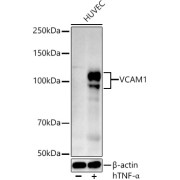
Vascular Cell Adhesion Molecule 1 (VCAM1) Antibody
Vascular Cell Adhesion Molecule 1 / CD106 (VCAM1) Antibody is a Rabbit Polyclonal antibody against Vascular Cell Adhesio…
Ver producto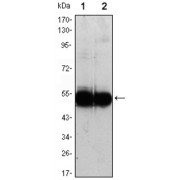
Vascular Cell Adhesion Molecule 1 (VCAM1) Antibody
This gene is a member of the Ig superfamily and encodes a cell surface sialoglycoprotein expressed by cytokine-activated…
Ver producto Vascular Cell Adhesion Molecule 1 (VCAM1) Antibody
Rabbit Polyclonal against the Vascular Cell Adhesion Molecule 1 / CD106 (VCAM1) protein.…
Ver producto