Human Mucin-1 (MUC1) Peptide

312€ (50 µg)
Por favor contáctenos para obtener información detallada sobre el precio y disponibilidad.
Name
Human Mucin-1 (MUC1) Peptide
Category
Proteins and Peptides
Provider
Abbexa
Reference
abx652277
Tested Applications
BL
Description
Human Mucin-1 (MUC1) Peptide is a synthetic Human Peptide.
Documentos del producto
Instrucciones
Data sheet
Especificaciones del producto
| Category | Proteins and Peptides |
| Immunogen Target | Mucin-1 (MUC1) |
| Host | Synthetic |
| Assay Type | Activity: Not tested Sequence Fragment: Pro902-Ala941 |
| Origin | Human |
| Conjugation | Unconjugated |
| Observed MW | Calculated MW: 3.76 kDa |
| Expression | Synthetic |
| Purity | > 95% |
| Size 1 | 50 µg |
| Size 2 | 100 µg |
| Size 3 | 200 µg |
| Size 4 | 500 µg |
| Size 5 | 1 mg |
| Form | Lyophilized |
| Tested Applications | BL |
| Buffer | Prior to lyophilization: 10 mM PBS, pH 7.4. |
| Availability | Shipped within 5-7 working days. |
| Storage | Store lyophilized form at 2-8°C for up to 1 month. For longer periods, store lyophilized or liquid at -80°C. Avoid repeated freeze–thaw cycles. |
| Dry Ice | No |
| UniProt ID | P15941 |
| Gene ID | 4582 |
| NCBI Accession | NP_001018016.1, NM_001018016.2 |
| OMIM | 113720 |
| Alias | Cancer antigen 15-3,CA 15-3,EMA,MCD,PEM,PUM,KL-6,MAM6,MCKD,PEMT,CD227,H23AG,MCKD1,MUC-1,ADMCKD, ADTKD2,Ca15-3,MUC-1,Episialin |
| Background | Protein MUC1 |
| Status | RUO |
| Note | THIS PRODUCT IS FOR RESEARCH USE ONLY. NOT FOR USE IN DIAGNOSTIC, THERAPEUTIC OR COSMETIC PROCEDURES. NOT FOR HUMAN OR ANIMAL CONSUMPTION. Reconstitute in ddH2O containing 10% DMF. The stock concentration should be between 0.1-1.0 mg/ml. Do not vortex. Concentration: Prior to lyophilization: 5 mg/ml |
Background
MUC1 (Mucin 1) is a large, transmembrane glycoprotein predominantly expressed on the surface of epithelial cells in various tissues, including the lungs, stomach, intestines, and the mammary glands. As a mucin protein, MUC1 plays a critical role in forming a protective mucous barrier on epithelial surfaces, which protects against environmental and microbial challenges. MUC1 also contributes to cell signaling and modulation of the immune response, particularly in epithelial cell inflammation. Due to its protective function on epithelial tissues, MUC1 expression is typically restricted to the apical surface of cells. However, in pathological states like cancer, MUC1 expression becomes dysregulated. Overexpression, aberrant glycosylation, and loss of polarity are commonly observed in many epithelial cancers, including breast, ovarian, and pancreatic cancers. These modifications contribute to tumor development, cancer cell survival, and metastasis, making MUC1 a key target for cancer diagnostics and therapeutics. In addition to cancer, MUC1 is associated with certain inflammatory and infectious diseases due to its role in the immune system.
Productos relacionados
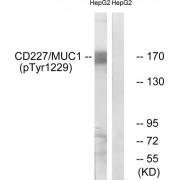
Mucin-1 Phospho-Tyr1229 (MUC1 pY1229) Antibody
Rabbit polyclonal antibody against CD227/MUC1 protein. Immunogen region is C-terminal. Specificity is as follows for the…
Ver producto
Mucin-1 (MUC1) Antibody
This gene is a member of the mucin family and encodes a membrane bound, glycosylated phosphoprotein. The protein is anch…
Ver producto
MUC1 (pY1229) Antibody
MUC1 is a member of the mucin family and a membrane bound, glycosylated phosphoprotein. The protein is anchored to the a…
Ver producto