Cell Adhesion Molecule 1 (CADM1) Antibody

195€ (20 µl)
Por favor contáctenos para obtener información detallada sobre el precio y disponibilidad.
Name
Cell Adhesion Molecule 1 (CADM1) Antibody
Category
Primary Antibodies
Provider
Abbexa
Reference
abx001553
Tested Applications
ELISA, WB
Description
CADM1 Antibody is a Rabbit Polyclonal antibody against CADM1. Homologous to the poliovirus receptor (PVR/CD155), the Nectin immunoglobulin superfamily comprises four known isoforms, Nectin 1, 2, 3 and 4 (also designated TSLC1). TSLC1 is encoded by a tumor-suppressor gene in human non-small-cell lung cancer mapping to chromosome 11q23.2. The TSLC1 protein is an N-linked membrane glycoprotein that co-localizes with the Actin filament-binding protein, afadin, at cadherin-based adherens junctions in MDCKII epithelial cells. TSLC1 also interacts with the tumor-suppressor gene product DAL-1 (for differentially expressed in adenocarcinoma of the lung protein 1) to target Actin rearragement and cellular motility. TSLC1 may also form homodimers that function in homophilic, intracellular adhesion. TSLC1 expression is reduced or absent in a number of characterized cancer cell lines including A549. In prostate and breast cancer, as well as in pancreatic ductal adenocarcinoma, the TSLC1 promoter is commonly silenced by hypermethylation. Unlike other Nectins, which are more widely expressed, TSLC1 is mainly expressed in the placenta.
Documentos del producto
Instrucciones
Data sheet
Especificaciones del producto
| Category | Primary Antibodies |
| Immunogen Target | Target: Cell Adhesion Molecule 1 (CADM1) Immunogen: Recombinant protein corresponding to CADM1. The exact sequence is proprietary. |
| Host | Rabbit |
| Reactivity | Human, Mouse, Rat |
| Assay Type | Concentration: > 0.2 mg/ml |
| Recommended Dilution | ELISA: 1 µg/ml, WB: 1/500 - 1/1000. Optimal dilutions/concentrations should be determined by the end user. |
| Clonality | Polyclonal |
| Conjugation | Unconjugated |
| Isotype | IgG |
| Observed MW | Calculated MW: 49 kDa Observed MW: 50 kDa |
| Purification | Purified by affinity chromatography. |
| Size 1 | 20 µl |
| Size 2 | 100 µl |
| Size 3 | 2 × 100 µl |
| Form | Liquid |
| Tested Applications | ELISA, WB |
| Buffer | PBS, pH 7.3, containing 0.05% Proclin-300, 50% glycerol. |
| Availability | Shipped within 5-10 working days. |
| Storage | Aliquot and store at -20°C. Avoid repeated freeze/thaw cycles. |
| Dry Ice | No |
| UniProt ID | Q9BY67 |
| Gene ID | 23705 |
| NCBI Accession | NP_055148.3 |
| OMIM | 605686 |
| Alias | BL2,ST17,IGSF4,NECL2,RA175,TSLC1,IGSF4A,Necl-2,SYNCAM,sgIGSF,sTSLC-1,synCAM1,Tumor suppressor in lung cancer 1,Nectin-like protein 2,Immunoglobulin superfamily member 4 |
| Background | Antibody anti-CADM1 |
| Status | RUO |
| Note | THIS PRODUCT IS FOR RESEARCH USE ONLY. NOT FOR USE IN DIAGNOSTIC, THERAPEUTIC OR COSMETIC PROCEDURES. NOT FOR HUMAN OR ANIMAL CONSUMPTION. |
Background
CADM1, also known as synaptic cell adhesion molecule (SynCAM1), is a member of the immunoglobulin superfamily and plays a pivotal role in cell-cell adhesion, synapse formation, and immune cell interactions. It is widely expressed in the nervous system, epithelial tissues, and immune cells, mediating interactions between neurons, epithelial cells, and immune cells. CADM1 is involved in the establishment and maintenance of synaptic connections, particularly in excitatory synapses, and contributes to neuronal network stability and plasticity. It has tumor-suppressive properties, with reduced expression frequently observed in cancers such as lung adenocarcinoma, where it is associated with increased invasiveness and metastasis. CADM1 interacts with scaffolding proteins and cytoskeletal regulators, facilitating intracellular signaling pathways that regulate cell polarity, migration, and proliferation. Structural studies have identified its extracellular immunoglobulin-like domains as critical for homophilic and heterophilic interactions, enabling diverse adhesive functions. CADM1 also plays a role in the immune system by modulating mast cell adhesion and interaction with nerve fibers. Dysregulation of CADM1 has been linked to neurodevelopmental disorders and inflammatory diseases, underscoring its significance in both physiological and pathological processes.
Productos relacionados
Cell Adhesion Molecule 1 (CADM1) Antibody
CADM1 Antibody is a Rabbit Polyclonal antibody against CADM1. Homologous to the poliovirus receptor (PVR/CD155), the Nec…
Ver producto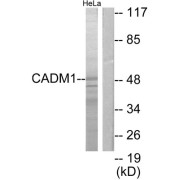
Cell Adhesion Molecule 1 (CADM1) Antibody
Rabbit polyclonal antibody against CADM1 protein. Immunogen region is C-terminal.…
Ver producto
Cell Adhesion Molecule 1 (CADM1) Antibody
Cell Adhesion Molecule 1 Antibody is a Rabbit Polyclonal antibody against Cell Adhesion Molecule 1.…
Ver producto