Apolipoprotein A4 (APOA4) Antibody
936€ (1 ml)
Por favor contáctenos para obtener información detallada sobre el precio y disponibilidad.
Name
Apolipoprotein A4 (APOA4) Antibody
Category
Primary Antibodies
Provider
Abbexa
Reference
abx171271
Tested Applications
WB, IHC, IF/ICC
Description
This product is currently in development. The lead time for this product may be several months. Please contact us at
Documentos del producto
Instrucciones
Data sheet
Especificaciones del producto
| Category | Primary Antibodies |
| Immunogen Target | Target: Apolipoprotein A4 (APOA4) |
| Host | Mouse |
| Reactivity | Cow |
| Recommended Dilution | WB: 0.01-2 µg/ml, IHC: 5-20 µg/ml, IF/ICC: 5-20 µg/ml. Optimal dilutions/concentrations should be determined by the end user. |
| Clonality | Monoclonal |
| Conjugation | Unconjugated |
| Purification | Purified by Protein A and Protein G affinity chromatography. |
| Size 1 | 1 ml |
| Form | Liquid |
| Tested Applications | WB, IHC, IF/ICC |
| Buffer | 0.01 M PBS, pH 7.4, containing 0.05% Proclin-300, 50% glycerol. |
| Availability | Please enquire. |
| Storage | Aliquot and store at -20°C. Avoid repeated freeze/thaw cycles. |
| Dry Ice | No |
| Alias | APOA4, apolipoprotein A4, APO A4,APO A-4,apoA-IV,apoAIV,apoA4,Apolipoprotein A-IV |
| Background | Antibody anti-APOA4 |
| Status | RUO |
| Note | THIS PRODUCT IS FOR RESEARCH USE ONLY. NOT FOR USE IN DIAGNOSTIC, THERAPEUTIC OR COSMETIC PROCEDURES. NOT FOR HUMAN OR ANIMAL CONSUMPTION. |
Background
APOA4 is a protein primarily synthesized in the small intestine and secreted into the bloodstream as a component of chylomicrons during dietary fat absorption. It plays a key role in lipid metabolism, facilitating the transport and metabolism of triglycerides and cholesterol. APOA4 has been shown to activate lecithin-cholesterol acyltransferase (LCAT), promoting cholesterol esterification and contributing to reverse cholesterol transport. Additionally, APOA4 exhibits anti-inflammatory and antioxidant properties, protecting against atherosclerosis and cardiovascular diseases. It also regulates satiety by interacting with receptors in the hypothalamus, contributing to appetite control and energy balance. Elevated APOA4 levels are associated with improved lipid profiles, while its deficiency can impair lipid transport and metabolism.
Productos relacionados
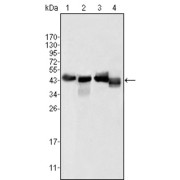
Apolipoprotein A4 (APOA4) Antibody
APOA4: apolipoprotein A4. Apoliprotein (apo) A4 gene contains 3 exons separated by two introns. A sequence polymorphism …
Ver producto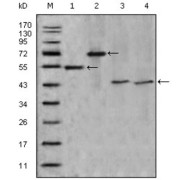
Apolipoprotein A4 (APOA4) Antibody
APOA4: apolipoprotein A4.Apoliprotein (apo) A4 gene contains 3 exons separated by two introns.A sequence polymorphism ha…
Ver producto Apolipoprotein A4 (APOA4) Antibody
APOA4 Antibody is a Mouse Monoclonal antibody against APOA4.…
Ver producto