SARS-CoV-2 Spike Protein RBD (BA.2.86 Variant) Protein
Por favor contáctenos para obtener información detallada sobre el precio y disponibilidad.
Description
SARS-CoV-2 Spike Protein RBD (BA.2.86 Variant) Protein is a recombinant Virus protein produced in a Mammalian cell expression system.
Documents del producto
Product specifications
| Category | Proteins and Peptides |
| Immunogen Target | SARS-CoV-2 RBD Spike (S BA.2.86) |
| Host | Mammalian cells |
| Assay Type | Activity: Not tested Sequence Fragment: Arg319-Lys529 Tag: C-terminal His tag |
| Origin | Virus |
| Observed MW | Calculated MW: 26.84 kDa |
| Expression | Recombinant |
| Purity | > 90% (SDS-PAGE) |
| Size 1 | 100 µg |
| Size 2 | 1 mg |
| Form | Lyophilized |
| Tested Applications | ELISA, WB, SDS-PAGE |
| Buffer | Prior to lyophilization: PBS pH 7.4, 1 mM EDTA, 4% Trehalose, 1% Mannitol. |
| Availability | Shipped within 5-12 working days. |
| Storage | Aliquot and store at -20 °C to 80°C. Avoid repeated freeze-thaw cycles. Shelf Life: 12 months. |
| Dry Ice | No |
| NCBI Accession | YP_009724390.1 |
| Background | Protein SARS |
| Status | RUO |
| Note | THIS PRODUCT IS FOR RESEARCH USE ONLY. NOT FOR USE IN DIAGNOSTIC, THERAPEUTIC OR COSMETIC PROCEDURES. NOT FOR HUMAN OR ANIMAL CONSUMPTION. Reconstitute in sterile water to produce a stock solution. |
Descripción
Related Products

SARS virus Sn Antibody
An outbreak of atypical pneumonia, referred to as severe acute respiratory syndrome (SARS) and first identified in Guangdong Province, China, has spread to several countries. The severity of this disease is such that the mortality rate appears to be ~3 to 6%. A number of laboratories worldwidehave undertaken the identification of the causative agent. The National Microbiology Laboratory in Canada obtained the Tor2 isolate from a patient in Toronto, and succeeded in growing a coronavirus-like agent in African Green Monkey Kidney (Vero E6) cells. This coronavirus has been named publicly by the World Health Organization and member laboratories as ?SARS virus? The SARS membrane proteins, including the major proteins S (Spike) and M (Membrane), are inserted into the endoplasmic reticulum Golgi intermediate compartment (ERGIC) while full length replicated RNA (+ strands) assemble with the N (nucleocapsid) protein. The virus then migrates through the Golgi complex and eventually exits the cell, likely by exocytosis. The site of viral attachment to the host cell resides within the S protein. Oligomeric spike (S) glycoproteins extend from SARS membranes. These integral membrane proteins assemble within the endoplasmic reticulum of infected cells and are subsequently endoproteolyzed in the Golgi, generating noncovalently associated S1 and S2 fragments. Once on the surface of infected cells and virions, peripheral S1 fragments bind carcinoembryonic antigen-related cell adhesion molecule (CEACAM) receptors, and this triggers membrane fusion reactions mediated by integral membrane S2 fragments.
Ver Producto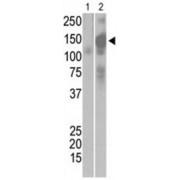
SARS virus Sm Antibody
An outbreak of atypical pneumonia, referred to as severe acute respiratory syndrome (SARS) and first identified in Guangdong Province, China, has spread to several countries. The severity of this disease is such that the mortality rate appears to be ~3 to 6%. A number of laboratories worldwidehave undertaken the identification of the causative agent. The National Microbiology Laboratory in Canada obtained the Tor2 isolate from a patient in Toronto, and succeeded in growing a coronavirus-like agent in African Green Monkey Kidney (Vero E6) cells. This coronavirus has been named publicly by the World Health Organization and member laboratories as ?SARS virus? The SARS membrane proteins, including the major proteins S (Spike) and M (Membrane), are inserted into the endoplasmic reticulum Golgi intermediate compartment (ERGIC) while full length replicated RNA (+ strands) assemble with the N (nucleocapsid) protein. The virus then migrates through the Golgi complex and eventually exits the cell, likely by exocytosis. The site of viral attachment to the host cell resides within the S protein. Oligomeric spike (S) glycoproteins extend from SARS membranes. These integral membrane proteins assemble within the endoplasmic reticulum of infected cells and are subsequently endoproteolyzed in the Golgi, generating noncovalently associated S1 and S2 fragments. Once on the surface of infected cells and virions, peripheral S1 fragments bind carcinoembryonic antigen-related cell adhesion molecule (CEACAM) receptors, and this triggers membrane fusion reactions mediated by integral membrane S2 fragments.
Ver Producto
SARS Spike Antibody
SARS Spike Antibody is a Mouse Monoclonal antibody against SARS Spike .
Ver Producto