Semaphorin-3C (SEMA3C) Antibody (FITC)
169€ (20 µg)
Por favor contáctenos para obtener información detallada sobre el precio y disponibilidad.
Name
Semaphorin-3C (SEMA3C) Antibody (FITC)
Category
Primary Antibodies
Provider
Abbexa
Reference
abx348749
Description
Semaphorin-3C (SEMA3C) Antibody (FITC) is a Rabbit Polyclonal antibody conjugated to FITC for the detection of Human SEMA3C.
Documentos del producto
Instrucciones
Data sheet
Especificaciones del producto
| Category | Primary Antibodies |
| Immunogen Target | Target: Semaphorin-3C (SEMA3C) Immunogen: Recombinant Human Semaphorin-3C protein (292-396 AA) |
| Host | Rabbit |
| Reactivity | Human |
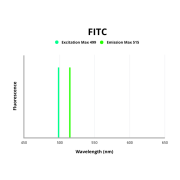
| Detection Method | Laser Line: 488 Excitation/Emission: 499/515 |
| Recommended Dilution | Optimal dilutions/concentrations should be determined by the end user. |
| Clonality | Polyclonal |
| Conjugation | FITC |
| Isotype | IgG |
| Purity | > 95% |
| Purification | Purified by Protein G chromatography. |
| Size 1 | 20 µg |
| Size 2 | 50 µg |
| Size 3 | 100 µg |
| Size 4 | 200 µg |
| Size 5 | 1 mg |
| Form | Liquid |
| Buffer | 0.01 M PBS, pH 7.4, 0.03% Proclin-300 and 50% glycerol. |
| Availability | Shipped within 5-10 working days. |
| Storage | Aliquot and store at -20°C. Avoid repeated freeze/thaw cycles. |
| Dry Ice | No |
| UniProt ID | Q99985 |
| Gene ID | 10512 |
| OMIM | 602645 |
| Alias | SemE,SEMAE,Semaphorin-E |
| Background | Antibody anti-SEMA3C |
| Status | RUO |
| Note | THIS PRODUCT IS FOR RESEARCH USE ONLY. NOT FOR USE IN DIAGNOSTIC, THERAPEUTIC OR COSMETIC PROCEDURES. NOT FOR HUMAN OR ANIMAL CONSUMPTION. |
Background
SEMA3C (Semaphorin 3C) is another key member of the class 3 semaphorins, primarily involved in neuronal pathfinding, cardiovascular development, and cancer biology. SEMA3C signals through neuropilin-2 (NRP2) and plexin receptors to regulate cellular behaviors such as migration, invasion, and adhesion. In cancer, SEMA3C is frequently upregulated, where it promotes tumor growth and metastasis by facilitating angiogenesis and modulating the tumor microenvironment. Its dual roles in development and oncogenesis make it a compelling target for both regenerative medicine and oncology.