Ribosomal Protein S14 (RPS14) Antibody

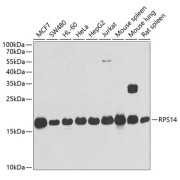
Product Graph
377€ (100 µg)

Por favor contáctenos para obtener información detallada sobre el precio y disponibilidad.

935106861
info@markelab.com
name
Ribosomal Protein S14 (RPS14) Antibody
category
Primary Antibodies
provider
Abbexa
reference
abx237460
tested applications
ELISA, WB, IHC, IF/ICC

Description

RPS14 Antibody is a Rabbit Polyclonal against RPS14.

Documents del producto

Instrucciones
Data sheet
Descargar

Product specifications

Category
Primary Antibodies
Immunogen Target
Target: Ribosomal Protein S14 (RPS14)
Immunogen: ribosomal protein S14
Host
Rabbit
Reactivity
Human, Mouse, Rat
Assay Type
Concentration: 2 mg/ml
Recommended Dilution
WB: 1/500 - 1/2000, IHC: 1/50 - 1/200, IF/ICC: 1/50 - 1/200. Optimal dilutions/concentrations should be determined by the end user.
Clonality
Polyclonal
Conjugation
Unconjugated
Isotype
IgG
Observed MW
Observed MW: 16 kDa
Purity
≥ 95% (SDS-PAGE)
Purification
Purified by immunogen affinity chromatography.
Size 1
100 µg
Form
Liquid
Tested Applications
ELISA, WB, IHC, IF/ICC
Buffer
PBS, pH 7.3, with 0.02% sodium azide and 50% glycerol.
Availability
Shipped within 5-12 working days.
Storage
Aliquot and store at -20°C. Avoid repeated freeze/thaw cycles.
Dry Ice
No
UniProt ID
P62263
Background
Antibody anti-RPS14
Status
RUO
Note
THIS PRODUCT IS FOR RESEARCH USE ONLY. NOT FOR USE IN DIAGNOSTIC, THERAPEUTIC OR COSMETIC PROCEDURES. NOT FOR HUMAN OR ANIMAL CONSUMPTION.

Descripción

Related Products

FNab07460

RPS14 antibody

Ribosomes, the organelles that catalyze protein synthesis, consist of a small 40S subunit and a large 60S subunit. Together these subunits are composed of 4 RNA species and approximately 80 structurally distinct proteins. This gene encodes a ribosomal protein that is a component of the 40S subunit. The protein belongs to the S11P family of ribosomal proteins. It is located in the cytoplasm. Transcript variants utilizing alternative transcription initiation sites have been described in the literature. As is typical for genes encoding ribosomal proteins, there are multiple processed pseudogenes of this gene dispersed through the genome. In Chinese hamster ovary cells, mutations in this gene can lead to resistance to emetine, a protein synthesis inhibitor. Multiple alternatively spliced transcript variants encoding the same protein have been found for this gene.

Ver Producto
abx005160

Ribosomal Protein S14 (RPS14) Antibody

RPS14 Antibody is a Rabbit Polyclonal antibody against RPS14. Ribosomes, the organelles that catalyze protein synthesis, consist of a small 40S subunit and a large 60S subunit. Together these subunits are composed of 4 RNA species and approximately 80 structurally distinct proteins. This gene encodes a ribosomal protein that is a component of the 40S subunit. The protein belongs to the S11P family of ribosomal proteins. It is located in the cytoplasm. Transcript variants utilizing alternative transcription initiation sites have been described in the literature. As is typical for genes encoding ribosomal proteins, there are multiple processed pseudogenes of this gene dispersed through the genome. In Chinese hamster ovary cells, mutations in this gene can lead to resistance to emetine, a protein synthesis inhibitor. Multiple alternatively spliced transcript variants encoding the same protein have been found for this gene.

Ver Producto
abx028554

Ribosomal Protein S14 (RPS14) Antibody

Ribosomes, the organelles that catalyze protein synthesis, consist of a small 40S subunit and a large 60S subunit. Together these subunits are composed of 4 RNA species and approximately 80 structurally distinct proteins. This gene encodes a ribosomal protein that is a component of the 40S subunit. The protein belongs to the S11P family of ribosomal proteins. It is located in the cytoplasm. Transcript variants utilizing alternative transcription initiation sites have been described in the literature. As is typical for genes encoding ribosomal proteins, there are multiple processed pseudogenes of this gene dispersed through the genome. In Chinese hamster ovary cells, mutations in this gene can lead to resistance to emetine, a protein synthesis inhibitor. Multiple alternatively spliced transcript variants encoding the same protein have been found for this gene.

Ver Producto