Rat Tissue Factor (F3) Protein

819€ (50 µg)
Por favor contáctenos para obtener información detallada sobre el precio y disponibilidad.
Name
Rat Tissue Factor (F3) Protein
Category
Proteins and Peptides
Provider
Abbexa
Reference
abx651446
Tested Applications
WB, SDS-PAGE
Description
Rat Tissue Factor (F3) Protein (Active) is an active Rat protein expressed in E. coli.
Documentos del producto
Instrucciones
Data sheet
Especificaciones del producto
| Category | Proteins and Peptides |
| Immunogen Target | Tissue Factor (F3) |
| Host | E. coli |
| Assay Type | Activity: Active Biological Activity: Tissue Factor (TF) is a cell surface glyprotein present in subendothelial tissue and leukocytes. TF is required for the initiation of thrombin formation from the zymogen prothrombin. It has been reported that Epidermal Growth Factor (EGF) can bind with the TF on the hemangioendotheliocytes, thus a binding ELISA assay was conducted to detect the interaction of recombinant rat TF and recombinant rat EGF. Briefly, TF was diluted serially in PBS with 0.01% BSA (pH 7.4). Duplicate samples of 100 μl were then transferred to EGF-coated microplate wells and incubated for 2 h at 37°C. Wells were washed with PBST and incubated for 1 h with anti-TF polyclonal antibody, then aspirated and washed 3 times. After incubation with HRP-conjugated secondary antibody, wells were aspirated and washed 3 times. TMB substrate solution was added and wells were incubated for 15-25 minutes at 37 °C. Finally, 50 μl stop solution was added to the wells and the absorbance was read at 450 nm immediately. Sequence Fragment: Gly30-Glu252 Tag: N-terminal His tag |
| Origin | Rat |
| Conjugation | Unconjugated |
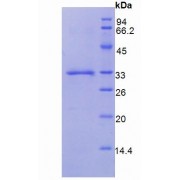
| Observed MW | Calculated MW: 26.9 kDa Observed MW: 29 kDa |
| Expression | Recombinant |
| Purity | > 95% |
| Size 1 | 50 µg |
| Size 2 | 100 µg |
| Size 3 | 200 µg |
| Size 4 | 500 µg |
| Size 5 | 1 mg |
| Form | Lyophilized |
| Tested Applications | WB, SDS-PAGE |
| Buffer | Prior to lyophilization: 20 mM Tris, 150 mM NaCl, pH 8.0, containing 0.01% Sarcosyl, 5% Trehalose. |
| Availability | Shipped within 5-7 working days. |
| Storage | Store lyophilized form at 2-8°C for up to 1 month. For longer periods, store lyophilized or liquid at -80°C. Avoid repeated freeze–thaw cycles. |
| Dry Ice | No |
| UniProt ID | P42533 |
| Gene ID | 25584 |
| Alias | TF,TFA,CD142,Coagulation factor III,Thromboplastin |
| Background | Protein F3 |
| Status | RUO |
| Note | THIS PRODUCT IS FOR RESEARCH USE ONLY. NOT FOR USE IN DIAGNOSTIC, THERAPEUTIC OR COSMETIC PROCEDURES. NOT FOR HUMAN OR ANIMAL CONSUMPTION. To keep the original salt concentration, we recommend reconstituting to the original concentration prior to lyophilization (see Concentration) in ddH2O. If a lower concentration is required, dilute in 20 mM Tris, 150 mM NaCl, pH 8.0. If a higher concentration is required, the product can be reconstituted directly in 20 mM Tris, 150 mM NaCl, pH 8.0, though please note that this will change the overall salt concentration. The stock concentration should be between 0.1-1.0 mg/ml. Do not vortex. Endotoxin Level: < 1.0 EU/µg (LAL method) Concentration: Prior to lyophilization: 400 µg/ml |
Background
Coagulation Factor III, also known as Tissue Factor (F3), is a critical glycoprotein in the initiation of the extrinsic pathway of the coagulation cascade. It acts as a receptor and cofactor for Factor VIIa, forming a complex that activates Factor X, which in turn leads to thrombin generation and clot formation. Tissue Factor is highly expressed in subendothelial tissues and is exposed upon vascular injury, where it serves as the primary trigger for hemostasis. Beyond its role in coagulation, F3 also participates in various signaling pathways, influencing inflammation, angiogenesis, and cancer progression through its interaction with protease-activated receptors (PARs). Dysregulation of Tissue Factor expression is associated with pathological conditions such as thrombosis, atherosclerosis, and malignancies. The study of F3 and its interactions, including its structure and binding properties, is crucial for developing targeted anticoagulant therapies and understanding its role in disease mechanisms. Its activity is often analyzed using advanced biochemical assays to elucidate its functions in both normal and pathological states.
Productos relacionados

Tissue Factor (F3) Antibody
F3 Antibody is a Rabbit Polyclonal antibody against F3. This gene encodes Tissue Factor (F3) which is a cell surface gly…
Ver producto
Human Tissue Factor (F3) Protein
Human Tissue Factor (F3) is a recombinant Human protein expressed in E. coli.…
Ver producto