Rat E3 Ubiquitin-Protein Ligase RING1 (RING1) ELISA Kit
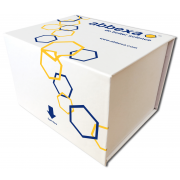
715€ (96 tests)
Por favor contáctenos para obtener información detallada sobre el precio y disponibilidad.
Name
Rat E3 Ubiquitin-Protein Ligase RING1 (RING1) ELISA Kit
Category
ELISA Kits
Provider
Abbexa
Reference
abx542422
Tested Applications
ELISA
Description
Rat E3 Ubiquitin-Protein Ligase RING1 (RING1) ELISA Kit is an ELISA Kit for the in vitro quantitative measurement of Rat E3 ubiquitin-protein ligase RING1 concentrations in tissue homogenates, cell lysates and other biological fluids.
Documentos del producto
Instrucciones
Data sheet
Especificaciones del producto
| Category | ELISA Kits |
| Immunogen Target | E3 Ubiquitin-Protein Ligase RING1 (RING1) |
| Reactivity | Rat |
| Detection Method | Colorimetric |
| Assay Data | Quantitative |
| Test Range | 0.156 ng/ml - 10 ng/ml |
| Recommended Dilution | Optimal dilutions/concentrations should be determined by the end user. |
| Size 1 | 96 tests |
| Form | Standard Form: Lyophilized |
| Tested Applications | ELISA |
| Sample Type | Tissue homogenates, cell lysates and other biological fluids. |
| Availability | Shipped within 5-15 working days. |
| Storage | Shipped at 4 °C. Upon receipt, store the kit according to the storage instruction in the kit's manual. |
| Dry Ice | No |
| UniProt ID | Q6MGB6 |
| Background | Elisa Kits for: RING1 |
| Status | RUO |
| Note | THIS PRODUCT IS FOR RESEARCH USE ONLY. NOT FOR USE IN DIAGNOSTIC OR THERAPEUTIC PROCEDURES. The range and sensitivity is subject to change. Please contact us for the latest product information. For accurate results, sample concentrations must be diluted to mid-range of the kit. If you require a specific range, please contact us in advance or write your request in your order comments. Please note that our kits are optimised for detection of native samples, rather than recombinant proteins. We are unable to guarantee detection of recombinant proteins, as they may have different sequences or tertiary structures to the native protein. The stability of the kit is determined by the rate of activity loss. The loss rate is less than 5% within the expiration date under appropriate storage conditions. To minimize performance fluctuations, operation procedures and lab conditions should be strictly controlled. It is also strongly suggested that the whole assay is performed by the same user throughout. |
Productos relacionados
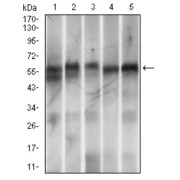
E3 Ubiquitin-Protein Ligase RING1 (RING1) Antibody
This gene belongs to the RING finger family, members of which encode proteins characterized by a RING domain, a zinc-bin…
Ver producto
Ring Finger Protein 1 (RING1) Antibody
This gene belongs to the RING finger family, members of which encode proteins characterized by a RING domain, a zinc-bin…
Ver producto
Ring Finger Protein 1 (RING1) Antibody
Ring Finger Protein 1 Antibody is a Rabbit Polyclonal antibody against Ring Finger Protein 1.…
Ver producto