Mouse Transforming Growth Factor Beta 1 (TGFb1) Protein
247€ (10 µg)
Por favor contáctenos para obtener información detallada sobre el precio y disponibilidad.
Name
Mouse Transforming Growth Factor Beta 1 (TGFb1) Protein
Category
Proteins and Peptides
Provider
Abbexa
Reference
abx069425
Tested Applications
WB, SDS-PAGE
Description
Mouse Transforming Growth Factor Beta 1 (TGFb1) is a recombinant Mouse protein expressed in E. coli.
Documentos del producto
Instrucciones
Data sheet
Especificaciones del producto
| Category | Proteins and Peptides |
| Immunogen Target | Transforming Growth Factor Beta 1 (TGFb1) |
| Host | E. coli |
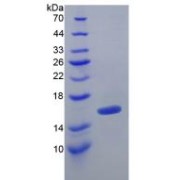
| Assay Type | Activity: Not tested Sequence Fragment: Ala279-Ser390 Tag: N-terminal His tag |
| Origin | Mouse |
| Conjugation | Unconjugated |
| Observed MW | Calculated MW: 14.3 kDa Observed MW (SDS-PAGE): 16 kDa |
| Expression | Recombinant |
| Purity | > 97% |
| Size 1 | 10 µg |
| Size 2 | 50 µg |
| Size 3 | 100 µg |
| Size 4 | 200 µg |
| Size 5 | 500 µg |
| Form | Lyophilized |
| Tested Applications | WB, SDS-PAGE |
| Buffer | Prior to lyophilization: 20 mM Tris, 150 mM NaCl, pH 8.0, containing 0.01% Sarcosyl, 5% Trehalose. |
| Availability | Shipped within 5-7 working days. |
| Storage | Store lyophilized form at 2-8°C for up to 1 month. For longer periods, store lyophilized or liquid at -80°C. Avoid repeated freeze–thaw cycles. |
| Dry Ice | No |
| UniProt ID | P04202 |
| Gene ID | 21803 |
| Alias | CED,DPD1,IBDIMDE LAP,TGF-beta1,TGFB,TGFbeta |
| Background | Protein TGFB1 |
| Status | RUO |
| Note | THIS PRODUCT IS FOR RESEARCH USE ONLY. NOT FOR USE IN DIAGNOSTIC, THERAPEUTIC OR COSMETIC PROCEDURES. NOT FOR HUMAN OR ANIMAL CONSUMPTION. To keep the original salt concentration, we recommend reconstituting to the original concentration prior to lyophilization (see Concentration) in ddH2O. If a lower concentration is required, dilute in 20 mM Tris, 150 mM NaCl, pH 8.0. If a higher concentration is required, the product can be reconstituted directly in 20 mM Tris, 150 mM NaCl, pH 8.0, though please note that this will change the overall salt concentration. The stock concentration should be between 0.1-1.0 mg/ml. Do not vortex. Concentration: Prior to lyophilization: 200 µg/ml |
Background
TGFB1 is a multifunctional cytokine that belongs to the transforming growth factor beta (TGF-β) family, which regulates cell proliferation, differentiation, apoptosis, and immune responses. TGFB1 is secreted as a latent complex that is activated in response to tissue injury, hypoxia, or cellular stress, enabling it to bind to its receptors and initiate downstream SMAD-dependent and non-SMAD signaling pathways. TGFB1 is a critical regulator of tissue homeostasis, embryonic development, and immune tolerance, where it suppresses inflammatory responses and promotes regulatory T cell (Treg) differentiation. In wound healing, TGFB1 induces extracellular matrix production and fibroblast activation, facilitating tissue repair and fibrosis. However, dysregulated TGFB1 signaling contributes to cancer progression by promoting epithelial-mesenchymal transition (EMT), immune evasion, and metastasis. It also drives fibrosis in chronic diseases, including pulmonary fibrosis and liver cirrhosis. Knockout studies reveal severe developmental defects, immune dysregulation, and impaired tissue repair, underscoring TGFB1's essential roles in cellular communication, immune modulation, and tissue remodeling.
Productos relacionados
Transforming Growth Factor Beta 1 (TGFB1) Antibody
TGFB1 Antibody is a Rabbit Polyclonal antibody against TGFB1. This gene encodes a member of the transforming growth fact…
Ver producto
Transforming Growth Factor Beta 1 (TGFb1) Antibody
This gene encodes a member of the transforming growth factor beta (TGFB) family of cytokines, which are multifunctional …
Ver producto
Transforming Growth Factor Beta-1 (TGFB1) Antibody
Rabbit polyclonal antibody against TGF beta 1 protein. Immunogen region is C-terminal.…
Ver producto