Mouse TNFSF11/RANKL (Tumor necrosis factor ligand superfamily member 11) ELISA Kit
Contáctenos para saber el precio
Por favor contáctenos para obtener información detallada sobre el precio y disponibilidad.
Name
Mouse TNFSF11/RANKL (Tumor necrosis factor ligand superfamily member 11) ELISA Kit
Category
ELISA Kits
Provider
FineTest
Reference
EM0194
Tested Applications
ELISA
Documentos del producto
Instrucciones
Data sheet
Especificaciones del producto
| Category | ELISA Kits |
| Reactivity | Mouse |
| Detection Method | Colorimetric |
| Assay Data | 4 hours |
| Assay Type | Sandwich ELISA, Double Antibody |
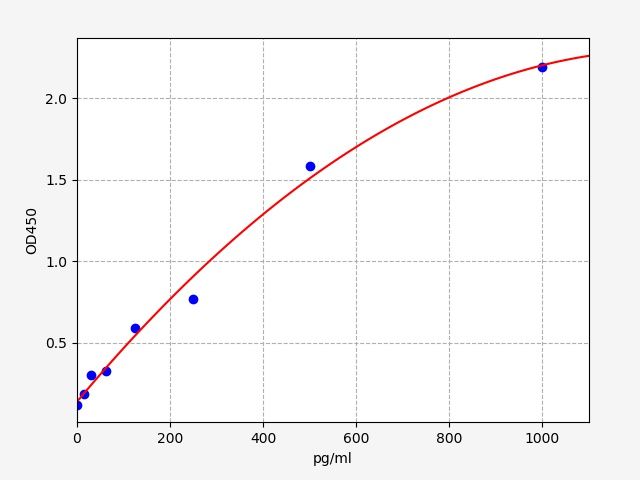
| Test Range | 15.625-1000pg/ml |
| Sensitivity | 9.375pg/ml |
| Size 1 | 96T |
| Tested Applications | ELISA |
| Sample Type | Serum, Plasma, Cell Culture Supernatant, cell or tissue lysate, Other liquid samples |
| Availability | Shipped within 10-14 working days. |
| Storage | 2-8 °C for 12 months |
| UniProt ID | O35235 |
| Alias | Tumor necrosis factor ligand superfamily member 11,ODF,OPGL,sOdf,CD254,OPTB2,RANKL,TNLG6B,TRANCE,hRANKL2,Osteoclast differentiation factor,Osteoprotegerin ligand,Receptor activator of nuclear factor kappa-B ligand, |
| Background | Elisa kits for TNFSF11 |
| Status | RUO |
Background
TNFSF11, also known as RANKL (Receptor Activator of Nuclear Factor Kappa-Β Ligand), is a member of the tumor necrosis factor (TNF) superfamily. This protein is critical for bone metabolism, immune system regulation, and lymphoid tissue development. RANKL is primarily expressed on osteoblasts, T cells, and stromal cells, playing a major role in osteoclast differentiation and activation by binding to its receptor, RANK (Receptor Activator of Nuclear Factor Kappa-Β). Through the interaction between RANK and RANKL, this signaling pathway facilitates bone remodeling by controlling osteoclast-mediated bone resorption. RANKL is also vital in immune responses and is implicated in the formation of lymph nodes and mammary gland development. The physiological significance of TNFSF11 is underscored by its role in balancing bone formation and resorption. Disruptions in RANKL signaling can lead to metabolic bone disorders such as osteoporosis and osteopetrosis. RANKL is also an area of interest in cancer research, particularly in understanding bone metastasis in certain cancers, as well as autoimmune diseases where its role in immune regulation may contribute to chronic inflammation.
Productos relacionados

Tumor Necrosis Factor Ligand Superfamily Member 11 / RANKL (TNFSF11) Antibody
TNFSF11 Antibody is a Rabbit Polyclonal antibody against TNFSF11. This gene encodes a member of the tumor necrosis facto…
Ver producto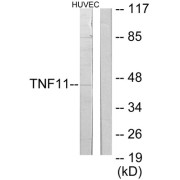
Tumor Necrosis Factor Ligand Superfamily Member 11 / RANKL (TNFSF11) Antibody
Rabbit polyclonal antibody against TNFSF11 protein. Immunogen region is Internal.…
Ver producto
Tumor Necrosis Factor Ligand Superfamily Member 11 / RANKL (TNFSF11) Antibody
Rabbit Polyclonal against the TNFSF11 protein.…
Ver producto