Mouse Gamma-crystallin D (CRYGD) Protein
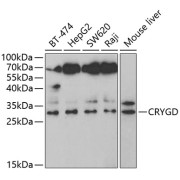
Product Graph
234€ (5 µg)

Por favor contáctenos para obtener información detallada sobre el precio y disponibilidad.

935106861
info@markelab.com
name
Mouse Gamma-crystallin D (CRYGD) Protein
category
Proteins and Peptides
provider
Abbexa
reference
abx680326
tested applications
SDS-PAGE

Description

Mouse Gamma-crystallin D (CRYGD) Protein is a recombinant protein expressed in E. coli.

Documents del producto

Instrucciones
Data sheet
Descargar

Product specifications

Category
Proteins and Peptides
Immunogen Target
Gamma-crystallin D (CRYGD)
Host
E. coli
Origin
Mouse
Conjugation
Unconjugated
Expression
Recombinant
Purity
> 95% (SDS-PAGE)
Size 1
5 µg
Size 2
20 µg
Size 3
1 mg
Form
Liquid
Tested Applications
SDS-PAGE
Availability
Shipped within 5-10 working days.
Dry Ice
No
Background
Protein CRYGD
Status
RUO
Note
This product is for research use only.   Not for human consumption, cosmetic, therapeutic or diagnostic use.

Descripción

Related Products

P4564

Recombinant Human CRYGD

Ver Producto
abx004390

Gamma-Crystallin D (CRYGD) Antibody

CRYGD Antibody is a Rabbit Polyclonal antibody against CRYGD. Crystallins are separated into two classes: taxon-specific, or enzyme, and ubiquitous. The latter class constitutes the major proteins of vertebrate eye lens and maintains the transparency and refractive index of the lens. Since lens central fiber cells lose their nuclei during development, these crystallins are made and then retained throughout life, making them extremely stable proteins. Mammalian lens crystallins are divided into alpha, beta, and gamma families; beta and gamma crystallins are also considered as a superfamily. Alpha and beta families are further divided into acidic and basic groups. Seven protein regions exist in crystallins: four homologous motifs, a connecting peptide, and N- and C-terminal extensions. Gamma-crystallins are a homogeneous group of highly symmetrical, monomeric proteins typically lacking connecting peptides and terminal extensions. They are differentially regulated after early development. Four gamma-crystallin genes (gamma-A through gamma-D) and three pseudogenes (gamma-E, gamma-F, gamma-G) are tandemly organized in a genomic segment as a gene cluster. Whether due to aging or mutations in specific genes, gamma-crystallins have been involved in cataract formation.

Ver Producto
abx030580

Gamma-Crystallin D (CRYGD) Antibody

Crystallins are separated into two classes: taxon-specific, or enzyme, and ubiquitous. The latter class constitutes the major proteins of vertebrate eye lens and maintains the transparency and refractive index of the lens. Since lens central fiber cells lose their nuclei during development, these crystallins are made and then retained throughout life, making them extremely stable proteins. Mammalian lens crystallins are divided into alpha, beta, and gamma families; beta and gamma crystallins are also considered as a superfamily. Alpha and beta families are further divided into acidic and basic groups. Seven protein regions exist in crystallins: four homologous motifs, a connecting peptide, and N and C-terminal extensions. Gamma-crystallins are a homogeneous group of highly symmetrical, monomeric proteins typically lacking connecting peptides and terminal extensions. They are differentially regulated after early development. Four gamma-crystallin genes (gamma-A through gamma-D) and three pseudogenes (gamma-E, gamma-F, gamma-G) are tandemly organized in a genomic segment as a gene cluster. Whether due to aging or mutations in specific genes, gamma-crystallins have been involved in cataract formation.

Ver Producto