Human T-Cell Surface Glycoprotein CD1a (CD1A) Protein
234€ (1 µg)
Por favor contáctenos para obtener información detallada sobre el precio y disponibilidad.
Name
Human T-Cell Surface Glycoprotein CD1a (CD1A) Protein
Category
Proteins and Peptides
Provider
Abbexa
Reference
abx680045
Tested Applications
SDS-PAGE
Description
Human T-Cell Surface Glycoprotein CD1a (CD1A) Protein is a recombinant protein produced in Sf9, Baculovirus cells.
Documentos del producto
Instrucciones
Data sheet
Especificaciones del producto
| Category | Proteins and Peptides |
| Immunogen Target | T-Cell Surface Glycoprotein CD1a (CD1A) |
| Host | Insect |
| Origin | Human |
| Conjugation | Unconjugated |
| Expression | Recombinant |
| Purity | > 85% (SDS-PAGE) |
| Size 1 | 1 µg |
| Size 2 | 5 µg |
| Size 3 | 50 µg |
| Form | Liquid |
| Tested Applications | SDS-PAGE |
| Availability | Shipped within 5-10 working days. |
| Dry Ice | No |
| Alias | R4,T6,CD1,FCB6,HTA1,T-cell surface glycoprotein CD1a,T-cell surface antigen T6/Leu-6,hTa1 thymocyte antigen |
| Background | Protein CD1A |
| Status | RUO |
| Note | THIS PRODUCT IS FOR RESEARCH USE ONLY. NOT FOR USE IN DIAGNOSTIC, THERAPEUTIC OR COSMETIC PROCEDURES. NOT FOR HUMAN OR ANIMAL CONSUMPTION. |
Background
CD1a Molecule (CD1A) is a member of the CD1 family of glycoproteins involved in presenting lipid and glycolipid antigens to T cells. Expressed predominantly on the surface of dendritic cells, Langerhans cells, and thymocytes, CD1A plays a vital role in the immune system by bridging innate and adaptive immunity. Structurally, CD1A is similar to major histocompatibility complex (MHC) class I molecules but specializes in binding lipids and presenting them to a unique subset of T cells, particularly natural killer T (NKT) cells. This interaction is critical for initiating immune responses against certain pathogens, such as Mycobacterium tuberculosis and fungi, that contain unique lipid antigens. CD1A's role extends to the regulation of skin immunity, given its high expression in Langerhans cells within the epidermis. Dysregulation or altered expression of CD1A has been implicated in autoimmune disorders, certain cancers, and inflammatory skin diseases, such as psoriasis. It is also a marker used in histopathology to identify Langerhans cell histiocytosis and other immune-related conditions, highlighting its clinical and diagnostic importance.
Productos relacionados
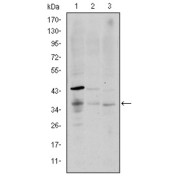
T-cell Surface Glycoprotein CD1a (CD1A) Antibody
CD1a is a non polymorphic MHC Class 1 related cell surface glycoprotein, expressed in association with beta 2 microglobu…
Ver producto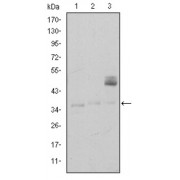
T-cell Surface Glycoprotein CD1a (CD1A) Antibody
CD1a is a non polymorphic MHC Class 1 related cell surface glycoprotein, expressed in association with Beta 2 microglobu…
Ver producto
T-cell Surface Glycoprotein CD1a (CD1A) Antibody
This gene encodes a member of the CD1 family of transmembrane glycoproteins, which are structurally related to the major…
Ver producto