Human Macrophage Mannose Receptor 1 (MRC1) Protein
208€ (10 µg)
Por favor contáctenos para obtener información detallada sobre el precio y disponibilidad.
Name
Human Macrophage Mannose Receptor 1 (MRC1) Protein
Category
Proteins and Peptides
Provider
Abbexa
Reference
abx654270
Tested Applications
WB, SDS-PAGE
Description
Human Mannose Receptor C Type 1 Like Protein 1 (MRC1) Protein is a recombinant Human protein expressed in E. coli.
Documentos del producto
Instrucciones
Data sheet
Especificaciones del producto
| Category | Proteins and Peptides |
| Immunogen Target | Macrophage Mannose Receptor 1 (MRC1) |
| Host | E. coli |
| Assay Type | Activity: Not tested Sequence Fragment: Please enquire. Tag: N-terminal His tag |
| Origin | Human |
| Conjugation | Unconjugated |
| Expression | Recombinant |
| Purity | > 90% |
| Size 1 | 10 µg |
| Size 2 | 50 µg |
| Size 3 | 100 µg |
| Size 4 | 200 µg |
| Size 5 | 500 µg |
| Form | Lyophilized |
| Tested Applications | WB, SDS-PAGE |
| Buffer | Prior to lyophilization: PBS, pH 7.4, containing 0.01% Sarcosyl, 1 mM DTT, 5% Trehalose and Proclin-300. |
| Availability | Shipped within 5-7 working days. |
| Storage | Store lyophilized form at 2-8°C for up to 1 month. For longer periods, store lyophilized or liquid at -80°C. Avoid repeated freeze–thaw cycles. |
| Dry Ice | No |
| Alias | Macrophage mannose receptor 1,MMR,hMR,CD206,MRC1L1,CLEC13D; CLEC13DL,C-type lectin domain family 13 member D,C-type lectin domain family 13 member D-like,Macrophage mannose receptor 1-like protein 1 |
| Background | Protein MRC1 |
| Status | RUO |
| Note | THIS PRODUCT IS FOR RESEARCH USE ONLY. NOT FOR USE IN DIAGNOSTIC, THERAPEUTIC OR COSMETIC PROCEDURES. NOT FOR HUMAN OR ANIMAL CONSUMPTION. To keep the original salt concentration, we recommend reconstituting to the original concentration prior to lyophilization (see Concentration) in ddH2O. If a lower concentration is required, dilute in PBS, pH 7.4. If a higher concentration is required, the product can be reconstituted directly in PBS, pH 7.4, though please note that this will change the overall salt concentration. The stock concentration should be between 0.1-1.0 mg/ml. Do not vortex. Concentration: Prior to lyophilization: 200 µg/ml |
Background
MRC1, or mannose receptor C-type 1, is a type I transmembrane protein predominantly found on the surface of macrophages, dendritic cells, and certain endothelial cells. The receptor, encoded by the MRC1 gene, plays an essential role in immune surveillance and host defense against pathogens. It is a member of the C-type lectin receptor (CLR) family, a group of proteins involved in recognizing carbohydrate structures on pathogens, facilitating their capture, and subsequently initiating immune responses. The mannose receptor (MR) recognizes and binds to mannose, fucose, and N-acetylglucosamine residues, which are common on the surface of microorganisms, thereby enabling the immune system to detect a broad range of pathogens, including bacteria, fungi, and viruses. This recognition mechanism is crucial for identifying foreign pathogens that display distinct glycosylation patterns on their surfaces compared to host cells. Beyond its role in pathogen recognition, MRC1 is involved in various physiological processes, including antigen processing and presentation, phagocytosis, and homeostasis. By mediating endocytosis of specific ligands and facilitating the clearance of glycoproteins and degraded cell components, MRC1 supports tissue repair and cellular turnover, making it integral to both innate immunity and tissue remodeling.
Productos relacionados
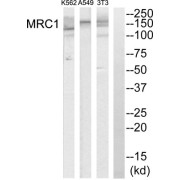
Macrophage Mannose Receptor 1 (MRC1) Antibody
Rabbit polyclonal antibody against MRC1 protein. Immunogen region is Internal.…
Ver producto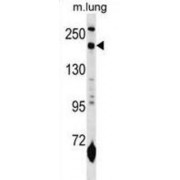
Macrophage Mannose Receptor 1 (MRC1L1) Antibody
This gene encodes a type I membrane receptor protein highly related to the mannose receptor C type 1 protein (MRC1). The…
Ver producto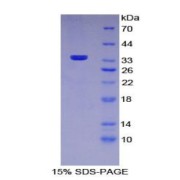
Mouse Macrophage Mannose Receptor 1 (MRC1) Protein
Mouse Mannose Receptor C Type 1 (MRC1) is a recombinant Mouse protein expressed in E. coli.…
Ver producto