Human FGFR4 (Fibroblast Growth Factor Receptor 4) ELISA Kit
Contáctenos para saber el precio
Por favor contáctenos para obtener información detallada sobre el precio y disponibilidad.
Name
Human FGFR4 (Fibroblast Growth Factor Receptor 4) ELISA Kit
Category
ELISA Kits
Provider
FineTest
Reference
EH3062
Tested Applications
ELISA
Documentos del producto
Instrucciones
Data sheet
Especificaciones del producto
| Category | ELISA Kits |
| Reactivity | Human |
| Detection Method | Colorimetric |
| Assay Data | 4 hours |
| Assay Type | Sandwich ELISA, Double Antibody |
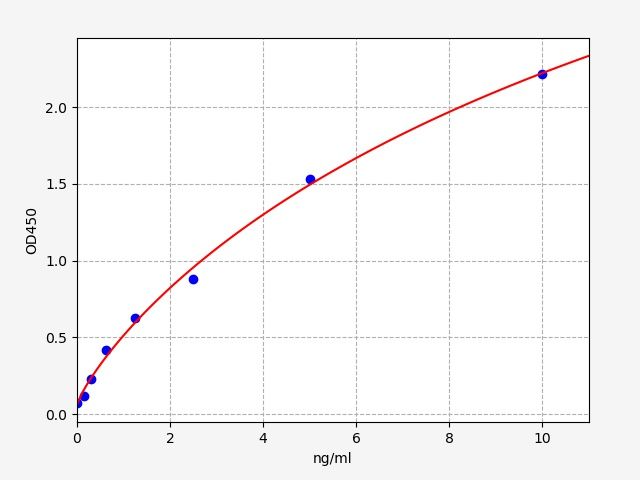
| Test Range | 0.156-10ng/ml |
| Sensitivity | 0.094ng/ml |
| Size 1 | 96T |
| Tested Applications | ELISA |
| Sample Type | Serum, Plasma, Cell Culture Supernatant, cell or tissue lysate, Other liquid samples |
| Availability | Shipped within 10-14 working days. |
| Storage | 2-8 °C for 12 months |
| UniProt ID | P22455 |
| Alias | TKF,JTK2,CD334,FGFR-4 |
| Background | Elisa kits for FGFR4 |
| Status | RUO |
Background
Fibroblast growth factor receptor 4 (FGFR4) FGFR4 is a member of the fibroblast growth factor receptor (FGFR) family, characterized as a transmembrane tyrosine kinase receptor that binds FGFs to regulate cell proliferation, differentiation, migration, and survival. Structurally, FGFR4 consists of an extracellular ligand-binding domain composed of three immunoglobulin-like loops, a single transmembrane domain, and an intracellular tyrosine kinase domain. FGFR4 plays essential roles in embryonic development, metabolism, and tissue homeostasis, particularly in liver, muscle, and endocrine tissues. Ligand binding activates downstream signaling cascades, including the MAPK, PI3K-AKT, and STAT pathways, which are critical for cell growth and survival. Dysregulation of FGFR4 signaling has been implicated in various cancers, such as hepatocellular carcinoma and rhabdomyosarcoma, where overexpression or mutation drives tumor growth and metastasis. Its selective expression in specific tissues and its involvement in metabolic regulation, including bile acid synthesis, highlight its specialized biological functions and potential as a therapeutic target in oncology and metabolic disorders.
Productos relacionados
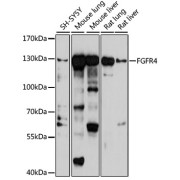
Fibroblast Growth Factor Receptor 4 (FGFR4) Antibody
FGFR4 Antibody is a Rabbit Polyclonal Antibody against FGFR4.…
Ver producto
Fibroblast Growth Factor Receptor 4 (FGFR4) Antibody
The protein encoded by this gene is a member of the fibroblast growth factor receptor family, where amino acid sequence …
Ver producto
FGFR4 (Phospho-Tyr642) Antibody
Rabbit polyclonal antibody against FGFR4 protein. Immunogen region is C-terminal. Specificity is as follows for the reac…
Ver producto