Human 14-3-3 Protein Eta (YWHAH) Protein

234€ (5 µg)
Por favor contáctenos para obtener información detallada sobre el precio y disponibilidad.
Name
Human 14-3-3 Protein Eta (YWHAH) Protein
Category
Proteins and Peptides
Provider
Abbexa
Reference
abx073498
Tested Applications
SDS-PAGE
Description
Human 14-3-3 Protein Eta (YWHAH) Protein is a recombinant protein kinase.
Documentos del producto
Instrucciones
Data sheet
Especificaciones del producto
| Category | Proteins and Peptides |
| Immunogen Target | 14-3-3 Protein Eta (YWHAH) |
| Host | E. coli |
| Assay Type | Activity: Not tested |
| Recommended Dilution | Optimal dilutions/concentrations should be determined by the end user. |
| Origin | Human |
| Expression | Recombinant |
| Purity | > 95% (SDS-PAGE) |
| Size 1 | 5 µg |
| Size 2 | 25 µg |
| Size 3 | 1 mg |
| Form | Liquid |
| Tested Applications | SDS-PAGE |
| Availability | Shipped within 5-10 working days. |
| Storage | Store at 4°C if the entire vial will be used within 2-4 weeks. Store at -20 °C for long term storage. For long term storage, it is recommended to add a carrier protein (0.1% HSA or BSA). Avoid repeated freeze/thaw cycles. |
| Dry Ice | No |
| UniProt ID | Q04917 |
| Alias | YWHAH, YWHA1, tyrosine 3-monooxygenase/tryptophan 5-monooxygenase activation protein eta |
| Background | Protein YWHAH |
| Status | RUO |
| Note | THIS PRODUCT IS FOR RESEARCH USE ONLY. NOT FOR USE IN DIAGNOSTIC, THERAPEUTIC OR COSMETIC PROCEDURES. NOT FOR HUMAN OR ANIMAL CONSUMPTION. |
Background
YWHAH, a member of the 14-3-3 protein family, acts as an adaptor molecule that binds phosphorylated serine/threonine residues on target proteins, regulating their stability, localization, and function. YWHAH is highly expressed in the brain, where it is involved in synaptic plasticity, neurotransmitter release, and neuronal development. It interacts with key signaling molecules in pathways such as MAPK, PI3K/Akt, and dopamine receptor signaling, influencing cellular processes like survival, growth, and stress response. Dysregulation of YWHAH is associated with neurological disorders such as schizophrenia, Parkinson’s disease, and rheumatoid arthritis, where altered signaling contributes to disease pathogenesis. Elevated levels of YWHAH have been detected in autoimmune diseases, highlighting its role as a biomarker. Knockout studies demonstrate impaired synaptic transmission, defects in neuronal signaling, and altered stress adaptation, emphasizing its importance in brain function, neurodevelopment, and immune regulation.
Productos relacionados
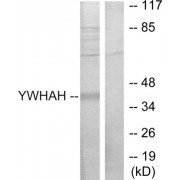
14-3-3 Protein Eta (YWHAH) Antibody
Rabbit polyclonal antibody against 14-3-3 Protein Eta (YWHAH). Immunogen region is Internal.…
Ver producto Human 14-3-3 Protein Eta (YWHAH) Protein
Human 14-3-3 Protein Eta (YWHAH) Protein is a recombinant protein kinase.…
Ver producto
14-3-3 Protein Eta (YWHAH) Antibody (Biotin)
14-3-3 Protein Eta (YWHAH) Antibody (Biotin) is a Rabbit Polyclonal antibody against 14-3-3 protein eta conjugated to Bi…
Ver producto