Bcl-2 Homologous Antagonist/Killer (BAK1) Antibody
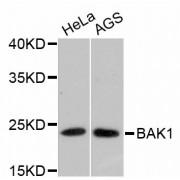
208€ (20 µl)
Por favor contáctenos para obtener información detallada sobre el precio y disponibilidad.
Name
Bcl-2 Homologous Antagonist/Killer (BAK1) Antibody
Category
Primary Antibodies
Provider
Abbexa
Reference
abx125297
Tested Applications
WB
Description
BAK1 Antibody is a Rabbit Monoclonal against BAK1.
Documentos del producto
Instrucciones
Data sheet
Especificaciones del producto
| Category | Primary Antibodies |
| Immunogen Target | Target: Bcl-2 Homologous Antagonist/Killer (BAK1) Immunogen: Recombinant fusion protein containing a sequence corresponding to amino acids 11-82 of human Bak. |
| Host | Rabbit |
| Reactivity | Human |
| Assay Type | Concentration: > 0.2 mg/ml |
| Recommended Dilution | WB: 1/100 - 1/500. Optimal dilutions/concentrations should be determined by the end user. |
| Clonality | Monoclonal |
| Conjugation | Unconjugated |
| Isotype | IgG |
| Observed MW | Calculated MW: 23 kDa Observed MW: 25 kDa |
| Purification | Purified by affinity chromatography. |
| Size 1 | 20 µl |
| Size 2 | 100 µl |
| Size 3 | 2 × 100 µl |
| Form | Liquid |
| Tested Applications | WB |
| Buffer | PBS, pH 7.3, containing 0.05% Proclin-300, 0.05% BSA, 50% glycerol. |
| Availability | Shipped within 5-10 working days. |
| Storage | Aliquot and store at -20°C. Avoid repeated freeze/thaw cycles. |
| Dry Ice | No |
| UniProt ID | Q16611 |
| Gene ID | 578 |
| NCBI Accession | NP_001179.1 |
| Background | Antibody anti-BAK1 |
| Status | RUO |
| Note | THIS PRODUCT IS FOR RESEARCH USE ONLY. NOT FOR USE IN DIAGNOSTIC, THERAPEUTIC OR COSMETIC PROCEDURES. NOT FOR HUMAN OR ANIMAL CONSUMPTION. |
Productos relacionados

Bcl-2 Homologous Antagonist/Killer (BAK1) Antibody
BAK1 Antibody is a Rabbit Polyclonal antibody against BAK1. The protein encoded by this gene belongs to the BCL2 protein…
Ver producto
Bcl-2 Homologous Antagonist/Killer (BAK1) Antibody
Rabbit polyclonal antibody against Bak protein. Immunogen region is N-terminal.…
Ver producto
Bak (BH3 Domain Specific) Antibody
BAK belongs to the BCL2 protein family. BCL2 family members form oligomers or heterodimers and act as anti or pro-apopto…
Ver producto