BAG Family Molecular Chaperone Regulator 1 (BAG1) Protein
234€ (5 µg)
Por favor contáctenos para obtener información detallada sobre el precio y disponibilidad.
Name
BAG Family Molecular Chaperone Regulator 1 (BAG1) Protein
Category
Proteins and Peptides
Provider
Abbexa
Reference
abx260589
Tested Applications
SDS-PAGE
Description
BAG1 is a recombinant protein.
Documentos del producto
Instrucciones
Data sheet
Especificaciones del producto
| Category | Proteins and Peptides |
| Immunogen Target | BAG1 |
| Assay Type | Activity: Not tested |
| Conjugation | Unconjugated |
| Expression | Recombinant |
| Purity | > 90% (SDS-PAGE) |
| Size 1 | 5 µg |
| Size 2 | 20 µg |
| Size 3 | 1 mg |
| Form | Liquid |
| Tested Applications | SDS-PAGE |
| Availability | Shipped within 5-10 working days. |
| Dry Ice | No |
| UniProt ID | Q99933 |
| Alias | HAP,BAG-1,RAP46,Bcl-2-associated athanogene 1,BAG family molecular chaperone regulator 1 |
| Background | Protein BAG1 |
| Status | RUO |
| Note | THIS PRODUCT IS FOR RESEARCH USE ONLY. NOT FOR USE IN DIAGNOSTIC, THERAPEUTIC OR COSMETIC PROCEDURES. NOT FOR HUMAN OR ANIMAL CONSUMPTION. |
Background
BAG cochaperone 1 (BAG1) is a cochaperone protein that interacts with heat shock proteins (HSPs) to regulate protein folding, degradation, and cellular stress responses BAG1 plays a critical role in modulating the activity of HSP70 and HSP90, chaperone proteins that assist in the proper folding and stabilization of client proteins It facilitates protein degradation by interacting with the E3 ubiquitin ligase system, ensuring the removal of misfolded or damaged proteins under cellular stress BAG1 is involved in cell survival, apoptosis, and the regulation of cell signaling, particularly in response to oxidative stress and other damaging conditions It also interacts with transcription factors and signaling molecules to influence gene expression and cellular differentiation BAG1 has been implicated in various cancers, where it promotes tumor cell survival and resistance to chemotherapy by stabilizing key oncogenic proteins Additionally, BAG1’s role in apoptosis regulation and cellular stress responses highlights its potential as a therapeutic target for diseases related to protein misfolding, cancer, and neurodegeneration
Productos relacionados

BAG Family Molecular Chaperone Regulator 1 (BAG1) Antibody
BAG1 Antibody is a Rabbit Polyclonal antibody against BAG1. The oncogene BCL2 is a membrane protein that blocks a step i…
Ver producto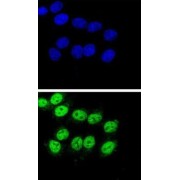
BAG Family Molecular Chaperone Regulator 1 (BAG1) Antibody
BAG1 binds to BCL2 and is referred to as BCL2-associated athanogene. It enhances the anti-apoptotic effects of BCL2 and …
Ver producto
BCL2 Associated Athanogene 1 (BAG1) Antibody
Rabbit Polyclonal against the BAG1 protein.…
Ver producto