Acetyl Coenzyme A Acetyltransferase 1 (ACAT1) Antibody (FITC)
169€ (20 µg)
Por favor contáctenos para obtener información detallada sobre el precio y disponibilidad.
Name
Acetyl Coenzyme A Acetyltransferase 1 (ACAT1) Antibody (FITC)
Category
Primary Antibodies
Provider
Abbexa
Reference
abx316734
Description
ACAT1 Antibody (FITC) is a Rabbit Polyclonal against ACAT1 conjugated to FITC.
Documentos del producto
Instrucciones
Data sheet
Especificaciones del producto
| Category | Primary Antibodies |
| Immunogen Target | Target: Acetyl Coenzyme A Acetyltransferase 1 (ACAT1) Immunogen: Recombinant Human Acetyl-CoA acetyltransferase, mitochondrial protein (76-106AA). |
| Host | Rabbit |
| Reactivity | Human |
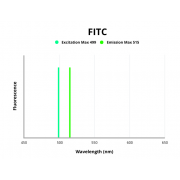
| Detection Method | Laser Line: 488 Excitation/Emission: 499/515 |
| Recommended Dilution | Optimal dilutions/concentrations should be determined by the end user. |
| Clonality | Polyclonal |
| Conjugation | FITC |
| Isotype | IgG |
| Purity | > 95% |
| Purification | Purified by Protein G. |
| Size 1 | 20 µg |
| Size 2 | 50 µg |
| Size 3 | 100 µg |
| Size 4 | 200 µg |
| Size 5 | 1 mg |
| Form | Liquid |
| Buffer | 0.01 M PBS, pH 7.4, 0.03% Proclin-300 and 50% Glycerol. |
| Availability | Shipped within 5-10 working days. |
| Storage | Aliquot and store at -20°C. Avoid exposure to light. Avoid repeated freeze/thaw cycles. |
| Dry Ice | No |
| UniProt ID | P24752 |
| Gene ID | 38 |
| NCBI Accession | NP_000010.1, NM_000019.3 |
| OMIM | 203750 |
| Alias | ACAT,MAT,T2,THIL,Acetoacetyl-CoA thiolase |
| Background | Antibody anti-ACAT1 |
| Status | RUO |
| Note | THIS PRODUCT IS FOR RESEARCH USE ONLY. NOT FOR USE IN DIAGNOSTIC, THERAPEUTIC OR COSMETIC PROCEDURES. NOT FOR HUMAN OR ANIMAL CONSUMPTION. |
Background
ACAT1, also known as mitochondrial acetoacetyl-CoA thiolase, is an enzyme localized in the mitochondria that catalyzes the reversible conversion of two molecules of acetyl-CoA into acetoacetyl-CoA, a critical step in ketone body synthesis and cholesterol metabolism. It is involved in energy production during periods of fasting or carbohydrate restriction by contributing to ketogenesis. ACAT1 also plays a role in the breakdown of branched-chain amino acids, linking it to amino acid metabolism. Dysregulation or mutations in the ACAT1 gene have been implicated in rare metabolic disorders such as beta-ketothiolase deficiency, which is characterized by the inability to properly metabolize ketogenic amino acids and fatty acids, leading to metabolic acidosis. Recent studies have also suggested a potential role for ACAT1 in cancer metabolism, where its activity is linked to metabolic reprogramming in tumor cells.
Productos relacionados
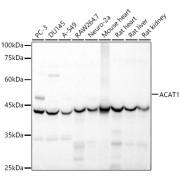
Acetyl Coenzyme A Acetyltransferase 1 (ACAT1) Antibody
ACAT1 Antibody is a Rabbit Polyclonal antibody against ACAT1. This gene encodes a mitochondrially localized enzyme that …
Ver producto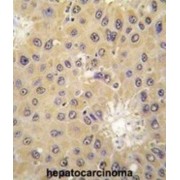
Acetyl Coenzyme A Acetyltransferase 1 (ACAT1) Antibody
ACAT1 is a mitochondrially localized enzyme that catalyzes the reversible formation of acetoacetyl-CoA from two molecule…
Ver producto
Acetyl Coenzyme A Acetyltransferase 1 (ACAT1) Antibody
Rabbit Polyclonal against the ACAT1 protein.…
Ver producto