Abhydrolase Domain Containing 14A (ABHD14A) Antibody (FITC)
169€ (20 µg)
Por favor contáctenos para obtener información detallada sobre el precio y disponibilidad.
Name
Abhydrolase Domain Containing 14A (ABHD14A) Antibody (FITC)
Category
Primary Antibodies
Provider
Abbexa
Reference
abx311305
Description
ABHD14A Antibody (FITC) is a Rabbit Polyclonal against ABHD14A conjugated to FITC.
Documentos del producto
Instrucciones
Data sheet
Especificaciones del producto
| Category | Primary Antibodies |
| Immunogen Target | Target: Abhydrolase Domain Containing 14A (ABHD14A) Immunogen: Recombinant human Alpha/beta hydrolase domain-containing protein 14A protein (56-258AA). |
| Host | Rabbit |
| Reactivity | Human |
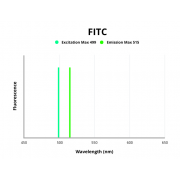
| Detection Method | Laser Line: 488 Excitation/Emission: 499/515 |
| Recommended Dilution | Optimal dilutions/concentrations should be determined by the end user. |
| Clonality | Polyclonal |
| Conjugation | FITC |
| Isotype | IgG |
| Purity | > 95% |
| Purification | Purified by Protein G. |
| Size 1 | 20 µg |
| Size 2 | 50 µg |
| Size 3 | 100 µg |
| Size 4 | 200 µg |
| Size 5 | 1 mg |
| Form | Liquid |
| Buffer | 0.01 M PBS, pH 7.4, 0.03% Proclin-300 and 50% Glycerol. |
| Availability | Shipped within 5-10 working days. |
| Storage | Aliquot and store at -20°C. Avoid exposure to light. Avoid repeated freeze/thaw cycles. |
| Dry Ice | No |
| UniProt ID | Q9BUJ0 |
| Gene ID | 25864 |
| Alias | DORZ1 |
| Background | Antibody anti-ABHD14A |
| Status | RUO |
| Note | THIS PRODUCT IS FOR RESEARCH USE ONLY. NOT FOR USE IN DIAGNOSTIC, THERAPEUTIC OR COSMETIC PROCEDURES. NOT FOR HUMAN OR ANIMAL CONSUMPTION. |
Background
ABHD14A (Abhydrolase Domain Containing 14A) is a member of the alpha/beta hydrolase superfamily, known for its diverse enzymatic roles, often involving lipid metabolism. ABHD14A is hypothesized to function as a hydrolase or esterase based on its conserved structural motifs, including the alpha/beta hydrolase fold. It is ubiquitously expressed in various tissues, suggesting a broad physiological significance. Emerging studies indicate potential roles in cellular signaling and metabolic pathways. The protein's exact substrates and biological functions remain under active investigation, with its dysregulation possibly linked to metabolic disorders or disease states. Further research is required to elucidate its precise role in health and disease.
Productos relacionados
Abhydrolase Domain Containing 14A (ABHD14A) Antibody
Rabbit polyclonal antibody against ABHD14A protein. Immunogen region is C-terminal.…
Ver producto
Abhydrolase Domain Containing 14A (ABHD14A) Antibody
Abhydrolase Domain Containing 14A Antibody is a Rabbit Polyclonal antibody against Abhydrolase Domain Containing 14A.…
Ver producto
Abhydrolase Domain Containing 14A (ABHD14A) Antibody
ABHD14A Antibody is a Rabbit Polyclonal against ABHD14A.…
Ver producto